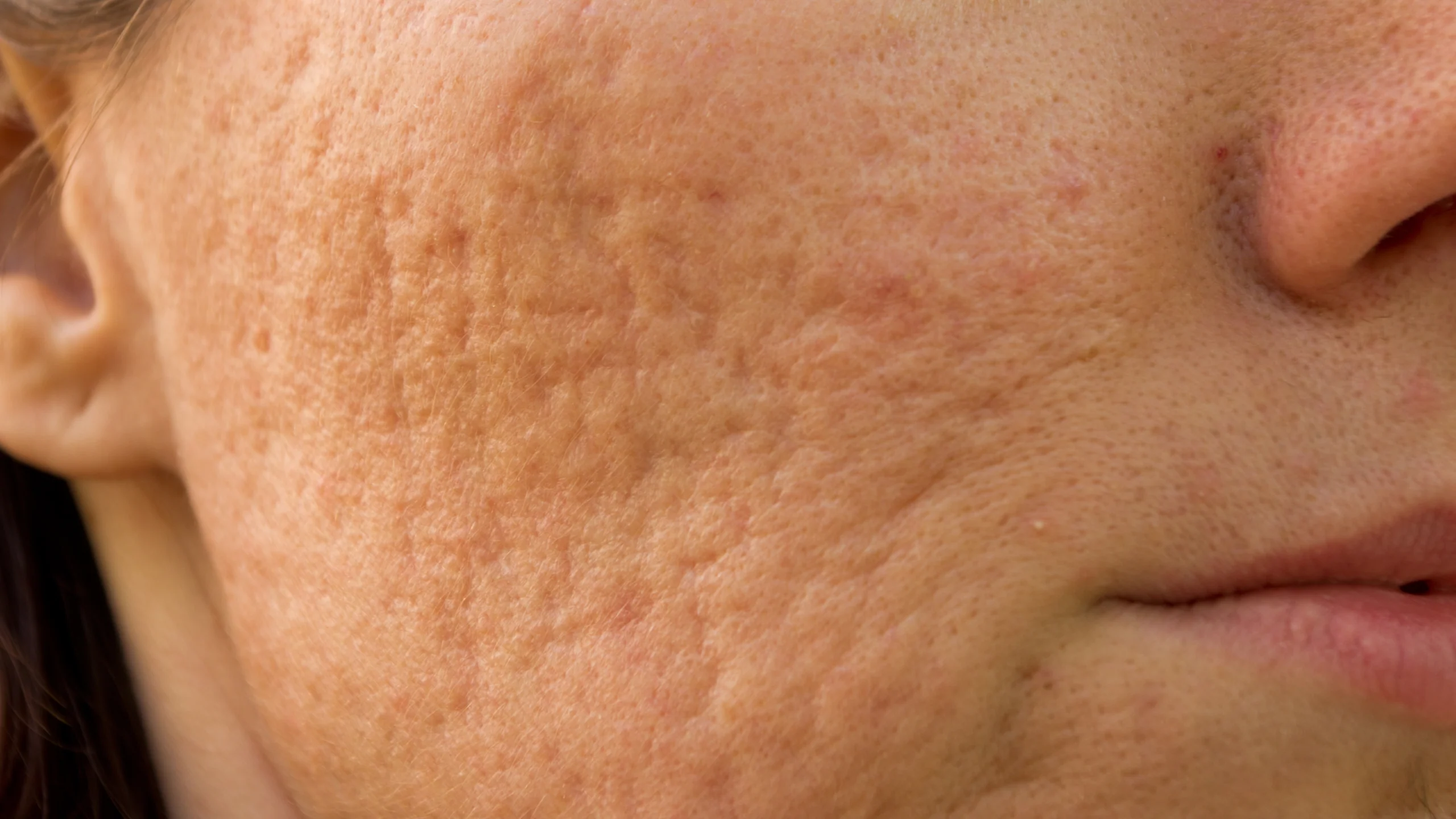
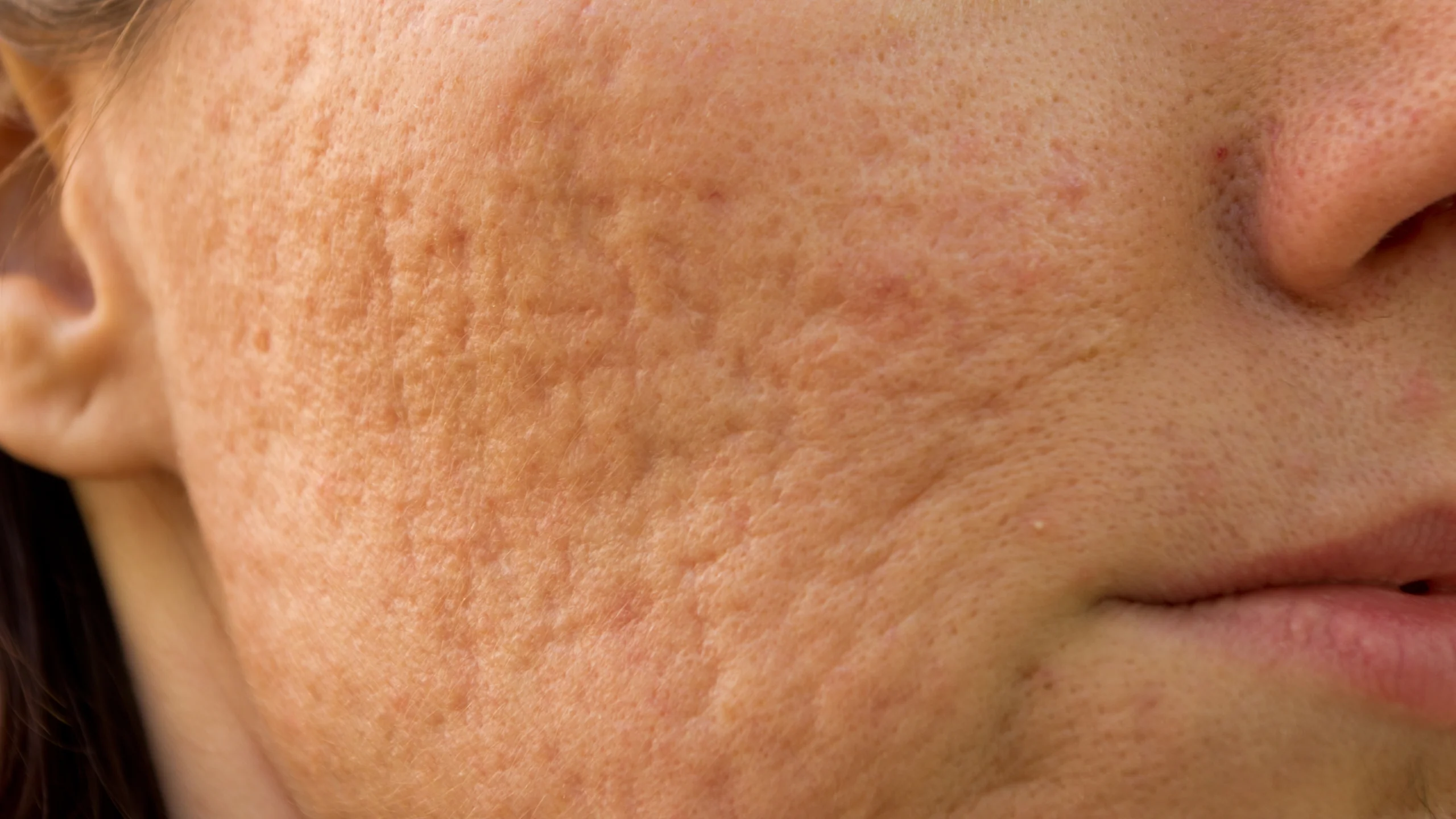
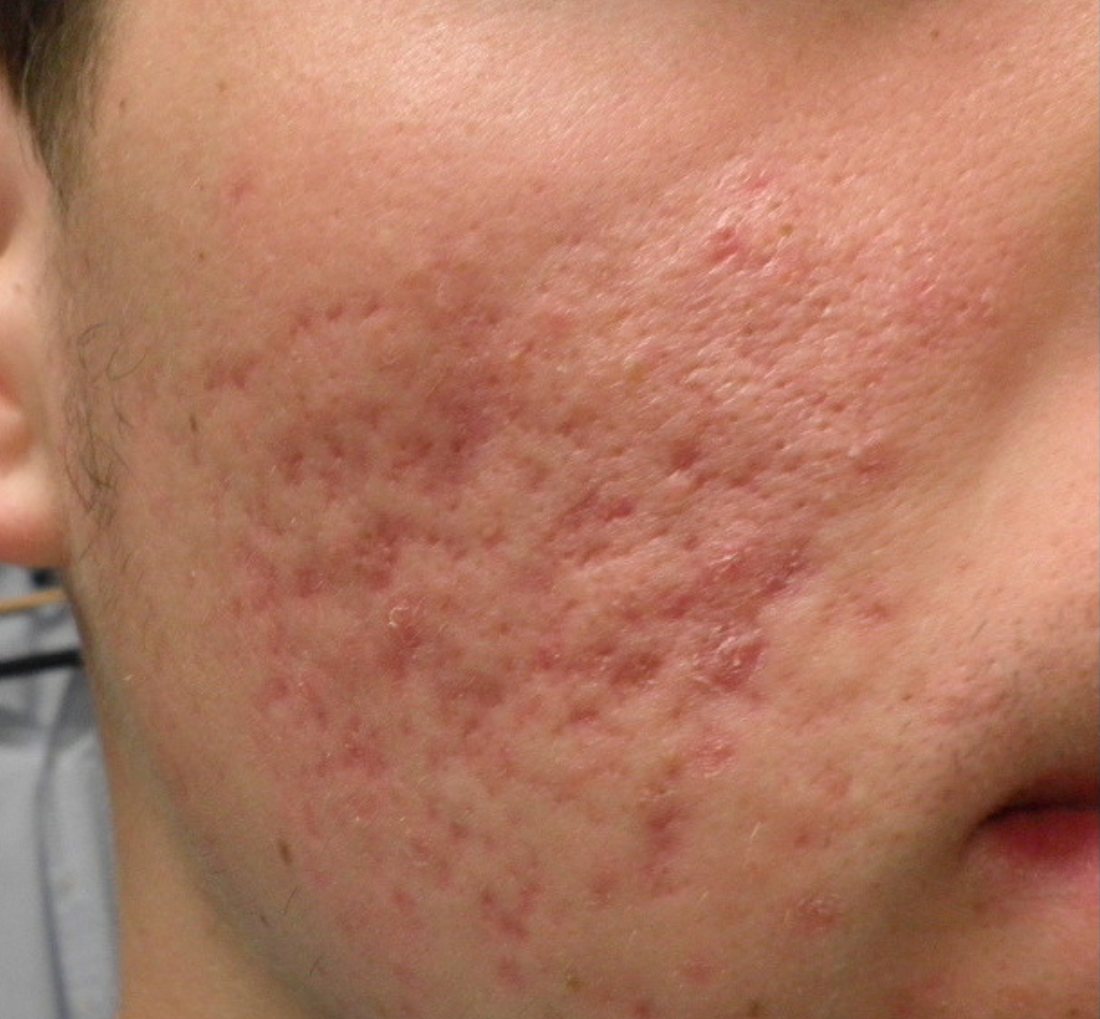
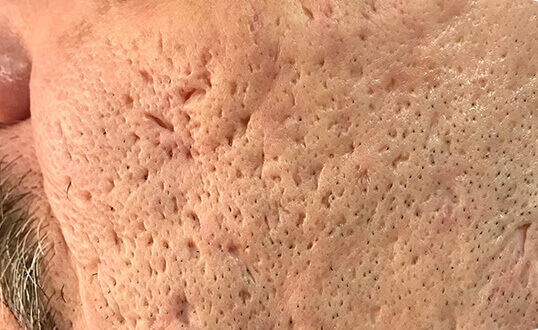
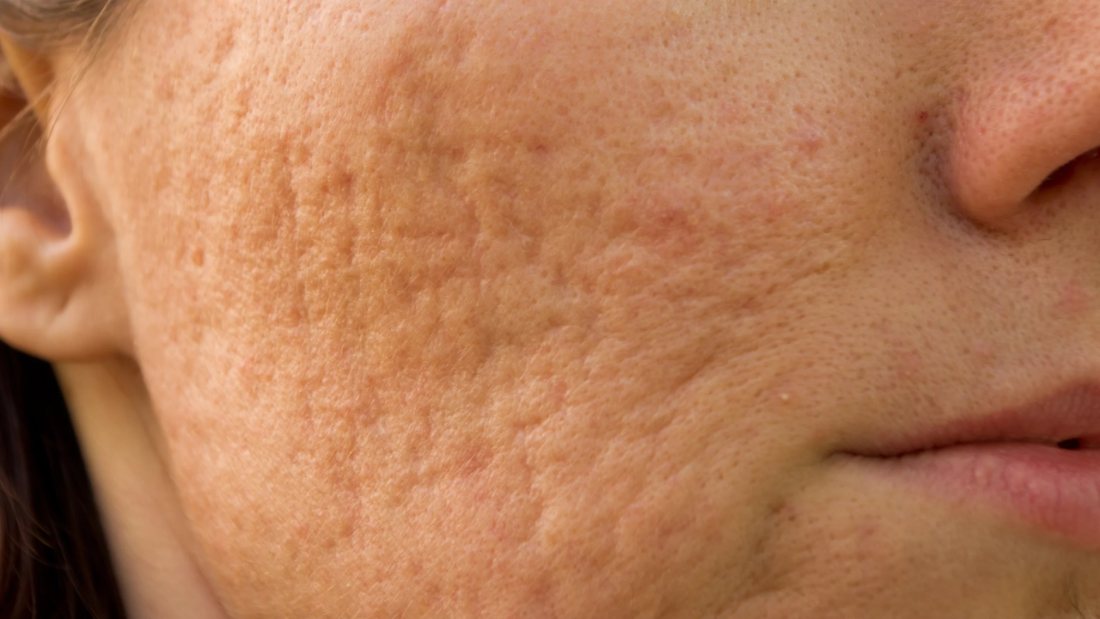
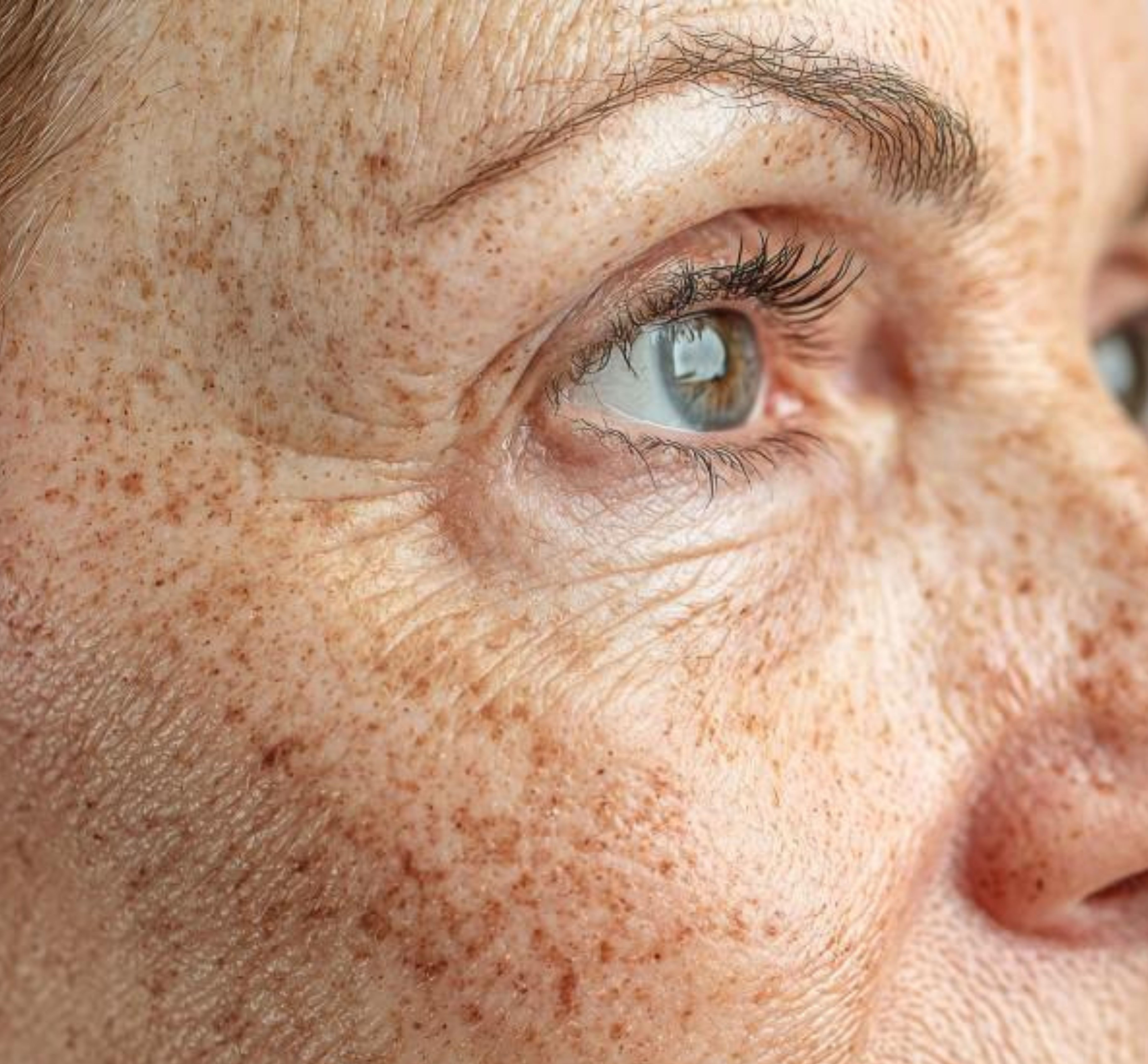
Boxcar scars are round or oval depressions with steep edges and a flat floor. Unlike ice pick scars, they sit within the dermis, which is why they respond well to lasers and to TCA painted onto the scar. The plan depends on two things: how deep they are, and your skin colour.
Can boxcar scars be treated? Yes — they are among the most responsive.
Treatment works on boxcar scars because they sit within reach. The questions that shape your plan are how deep they are, how wide they are, and how much pigment your skin carries.
01
They sit in the dermis.The floor of a boxcar scar is in the same layer lasers treat, so resurfacing can lift it.
02
Small ones are treated like ice picks.Narrow, deep boxcars respond to focal TCA or a size-matched punch, just like ice pick scars.
03
Broad ones need TCA at the edge.Painting TCA on the sharp margin, not the whole floor, softens the edge without enlarging the scar.
04
Skin colour sets the pace.Lighter skin can often be treated in one deep session. Darker skin gets the same result over 2–4 gentler sessions.
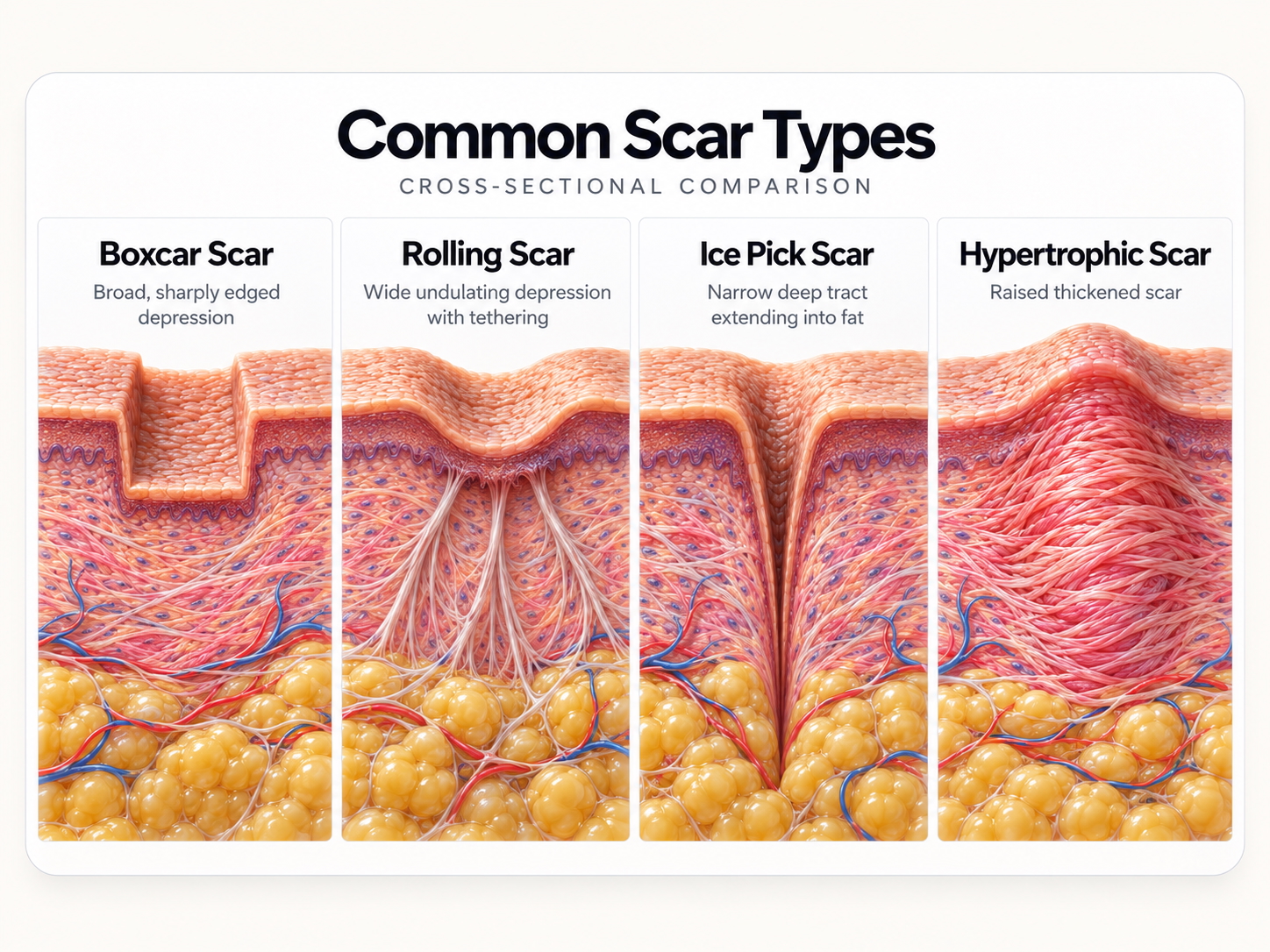
Boxcar scars (left) have vertical walls and a flat floor. Unlike ice pick scars, the floor stays within the dermis. Not to scale.
Lasers treat within the dermis — the same layer that holds a boxcar scar.
Depth is the whole story
A boxcar scar sits where lasers work.
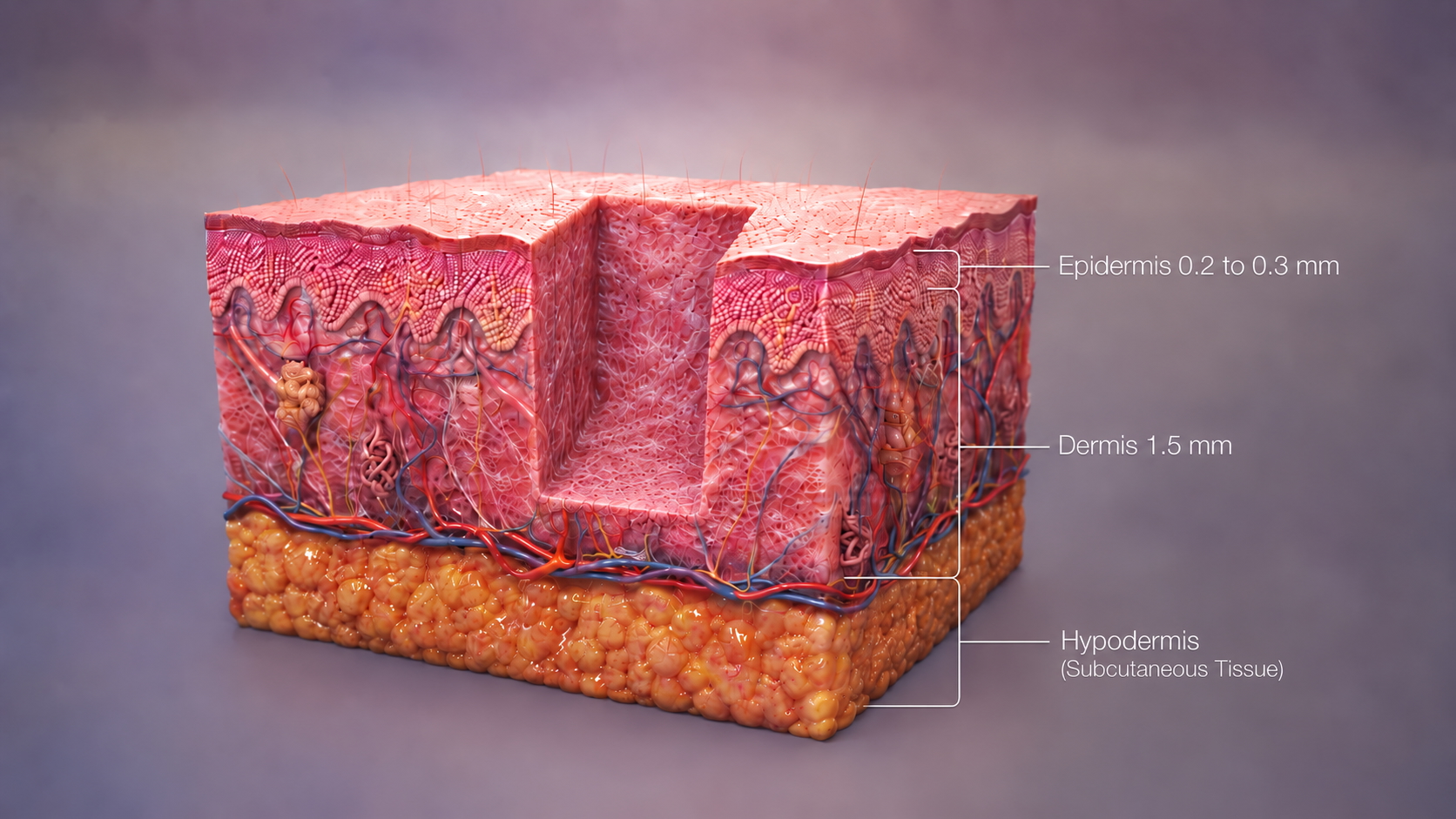
Your skin has three layers: the epidermis on top (0.2–0.3 mm), the dermis beneath it (around 1.5 mm on the face) and then the subcutaneous fat.
Ice pick scars run through the dermis into the fat, beyond a laser's reach. A boxcar scar is different: its walls and floor sit within the dermis. CO₂ and erbium lasers, fractional and non-ablative lasers all work in that layer, so they can reach the whole scar and remodel it.
What a laser does here
Softens the sharp shoulders and stimulates collagen to lift the floor of the scar.
Why depth still matters
Shallow boxcars can be levelled quickly. Deep ones need more depth — which is where skin colour comes in.
Where TCA fits
For small boxcars, TCA placed into the scar. For broad ones, TCA painted onto the edge only.
Compare: an ice pick scarAn ice pick tract runs past the dermis into the fat, below a laser's reach. A boxcar scar stops within the dermis.
123
1
Sharp shoulderThe steep edge that casts a shadow. Softened by laser or TCA painted to the edge.
2
Vertical wallOpening and floor are the same width — the key difference from an ice pick scar.
3
Flat floor, in the dermisStill above the fat, so within reach of CO₂ and erbium lasers.
Illustration of a deep boxcar scar. Epidermis 0.2–0.3 mm, dermis about 1.5 mm, then subcutaneous fat. Not to scale.
Depth vs reach · indicativeBoxcar scars sit within the range lasers treat.
Indicative only. Depths vary with the device, settings and site. How deep it is safe to go in one session depends on your skin colour — see the chart below.
Which kind of boxcar scar do you have?
All boxcar scars have sharp edges and a flat floor. Their size and depth decide which tool leads.
Boxcar or ice pick?Look at the floor. If you can see a flat base under side lighting, it is a boxcar. If it stays a dark pinpoint from every angle, it is an ice pick — see the ice pick page.
Most people have a mixBoxcar scars usually sit alongside ice pick and rolling scars. Your written report maps each type and puts them in order.
Matching treatment to a boxcar scar
Small boxcars are treated much like ice pick scars. Broad ones are treated at the edge. And because every boxcar sits in the dermis, lasers are a mainstay rather than an add-on.
Boxcar typeTreatment of choiceWhyDowntimeSessions
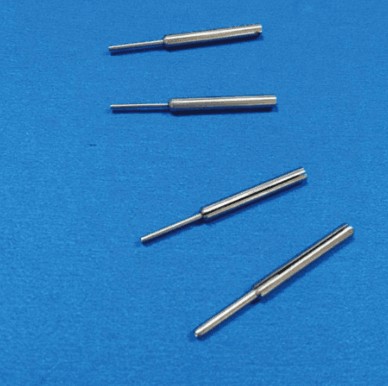
Small, narrow (< 2 mm)TCA CROSS, FUE punchBehaves like an ice pick. Focal treatment reaches the base.Low1–3
Broad (> 3 mm)TCA paint to the edgeTreats the sharp margin only, so the scar is not enlarged.Low–moderate3
Mixed / polymorphicTCA paint to the sharp sideThe sloping side is left alone to avoid scar extension.Low–moderate3
Shallow, lighter skinFully ablative CO₂ or erbiumCan be levelled to the floor in a single session.7–10 days1
Shallow or deep, darker skinFractional CO₂ / erbium, stagedSame depth, split across sessions to protect pigment.3–5 days each2–4
Texture between scarsNon-ablative laserBlends the surrounding skin with minimal downtime.Minimal3–5
Indicative — your plan is confirmed at consultation.
Boxcar scars are the good news of acne scarring. They sit within reach — the skill is in choosing how deep to go, and how fast, for your skin.
My published technique · Dermatologic Surgery 2022
Broad boxcars: TCA painted to the edge
Painting TCA across the whole floor of a broad scar risks slow healing and making the scar bigger. In my study, broad boxcars had TCA painted on the margin only, and mixed scars only on their sharp side — using a fine brush instead of the usual wooden applicator.
90%TCA concentration, applied with a fine brush
3Sessions, 7–9 weeks apart
100%Good or excellent outcomes in those who completed
6.2 daysAverage time to heal after each session
1
Clean and mark
The skin is cleaned with acetone and a reference dot is placed by each scar, so the same scars are treated every session.
2
Small boxcars: into the base
Classic boxcars with sharp shoulders have TCA painted directly onto the floor.
3
Broad boxcars: the edge only
Scars wider than 2–3 mm have TCA painted on the margin, not the whole floor, to avoid enlarging them.
4
Mixed scars: the sharp side only
The sloping side is left untreated. Frosting appears within 8–16 seconds.
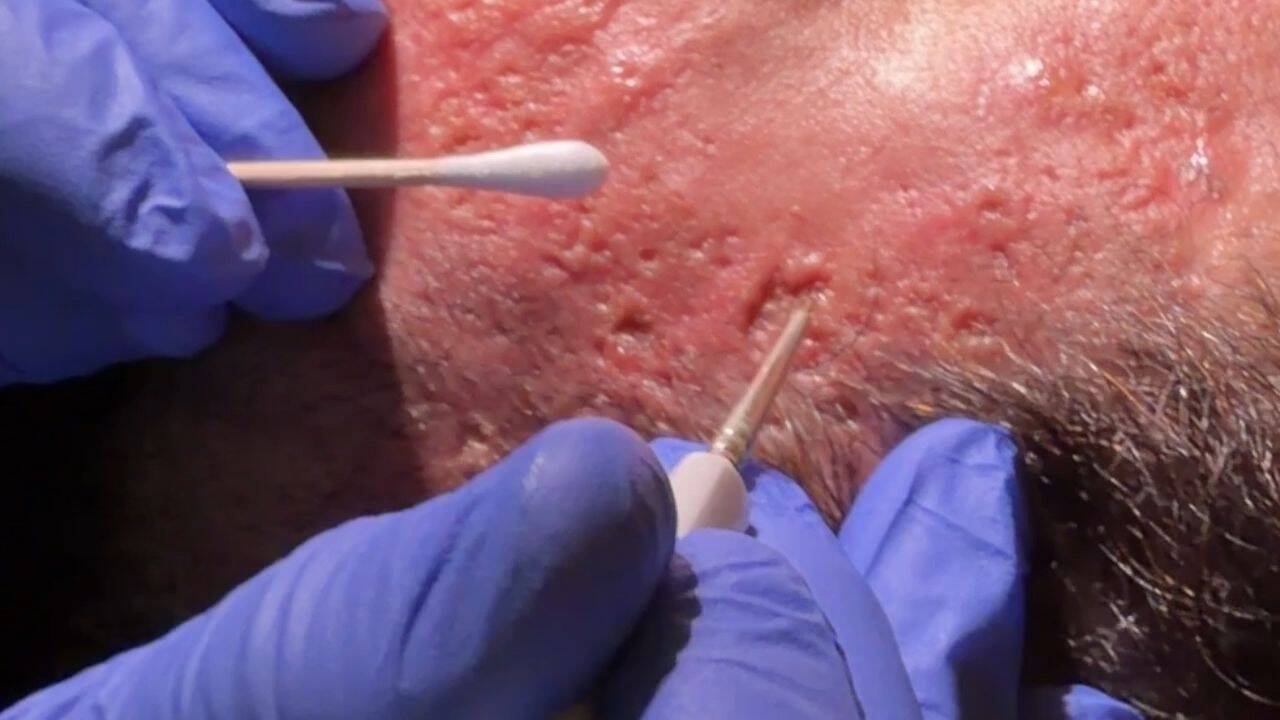
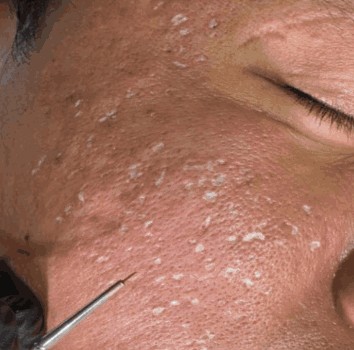
90% TCA painted onto boxcar and mixed scars with a fine brush (Sun & Lim, Fig. 2).
Sun & Lim, Dermatologic Surgery 2022 — download below.
Once the edges are softened, lasers take over to blend the surrounding texture.
Why darker skin takes more sessions
Same scar, same result — a different pace for different skin.
Treating a boxcar scar means resurfacing down to its floor. In lighter skin that can often be done in one fully ablative CO₂ or erbium session. In darker skin, going that deep at once risks post-inflammatory hyperpigmentation (darkening) or hypopigmentation (lightening). So the same depth is reached gradually, over 2–4 sessions depending on skin colour.
Depth of each session · shallow boxcarEach block = one session. Column = scar depth, surface to floor.
Lighter skinFitzpatrick I–II
SurfaceScar floor
S1
1 sessionFull depth
Fully ablative CO₂ or erbium in one session.Low pigment risk. The scar floor can be reached in one pass.
Olive skinFitzpatrick III
SurfaceScar floor
S1
S2
2 sessionsAbout ½ each
Two sessions, each about half the depth.Moderate risk of darkening if taken too deep at once.
Light brown skinFitzpatrick IV
SurfaceScar floor
S1
S2
S3
3 sessionsAbout ⅓ each
Three gentler sessions, with pigment preparation.Higher risk of darkening, and of lightening with deep passes.
Brown to dark skinFitzpatrick V–VI
SurfaceScar floor
S1
S2
S3
S4
4 sessionsAbout ¼ each
Four conservative sessions, often fractional.Highest risk of both darkening and lightening. Depth is kept conservative every time.
Deep boxcars follow the same logic with more total depth. Pigment preparation beforehand and strict sun protection afterwards are part of the treatment in skin types III–VI — and in my TCA study, patients with darker skin types actually had more excellent outcomes.
⇆
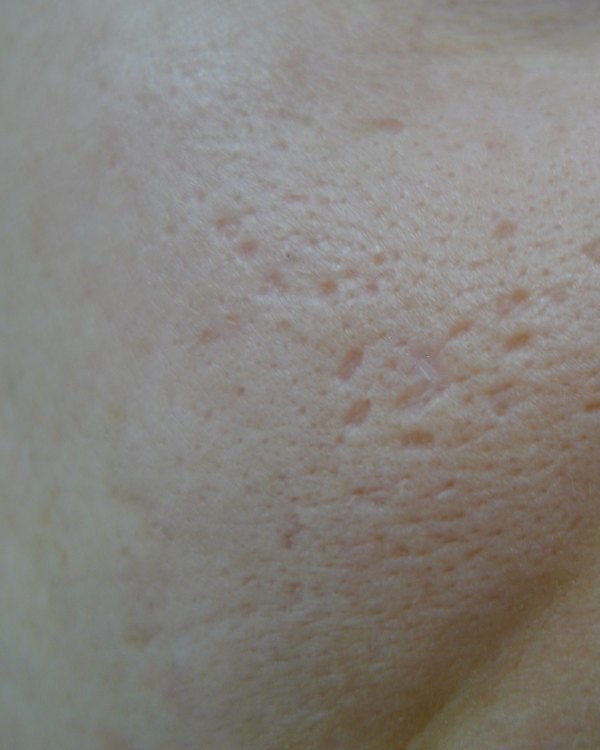
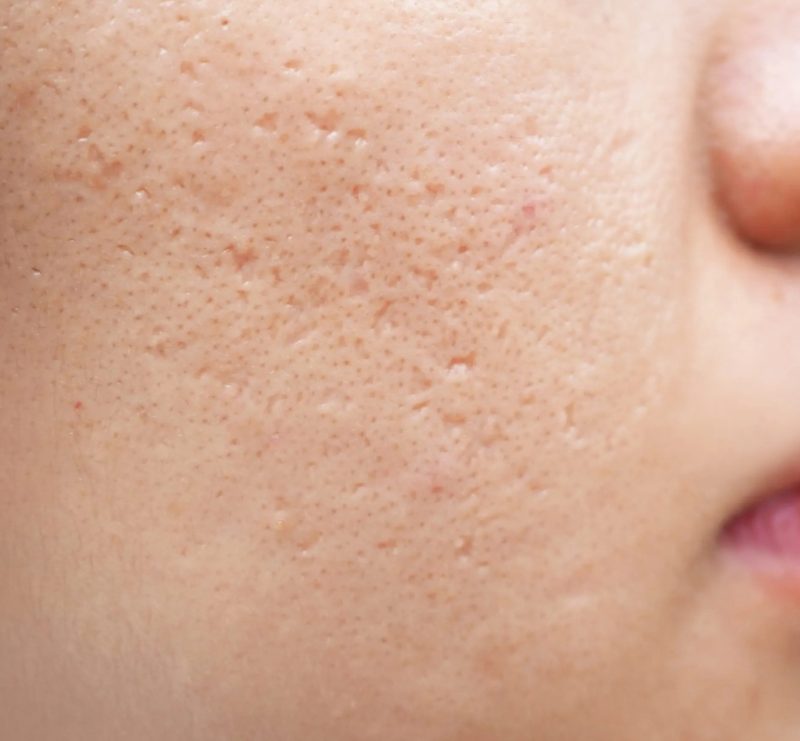
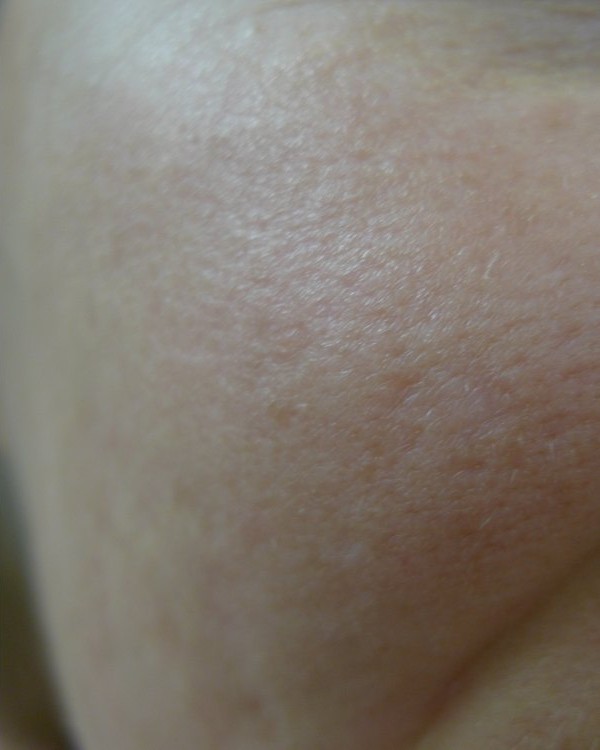
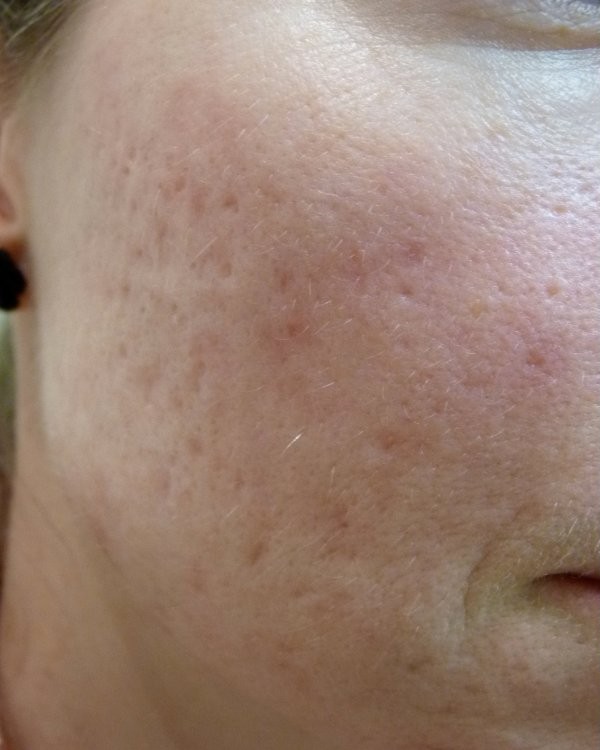
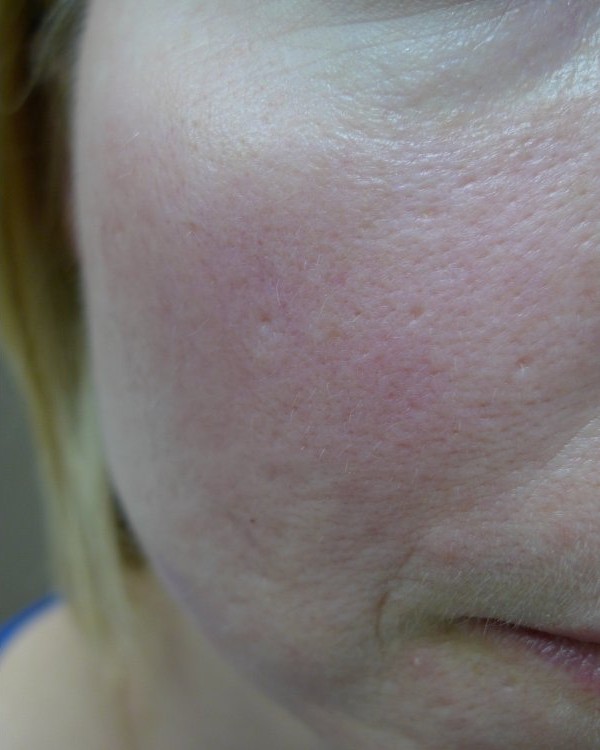
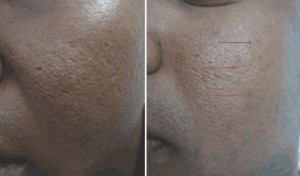
BeforeAfter
Boxcar scars, TCA
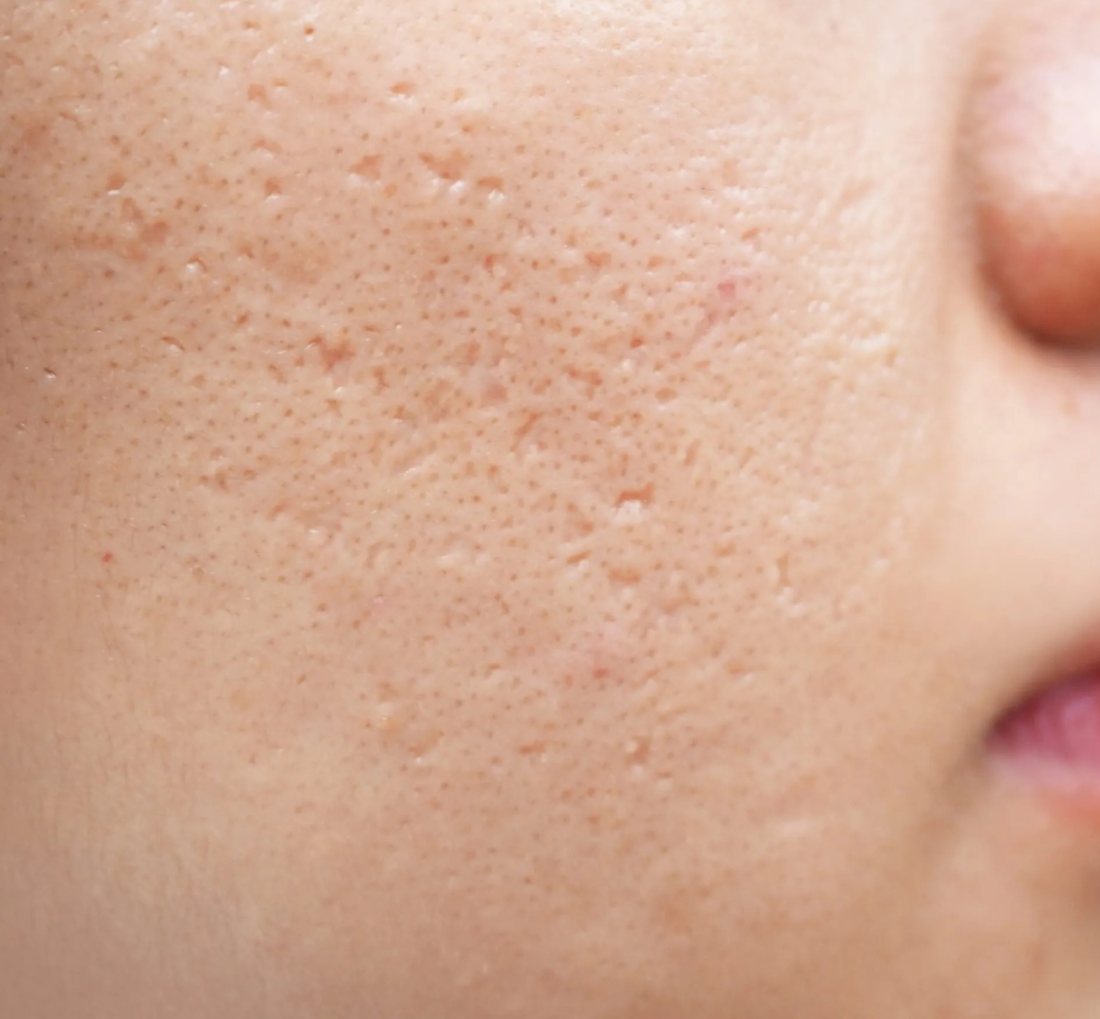
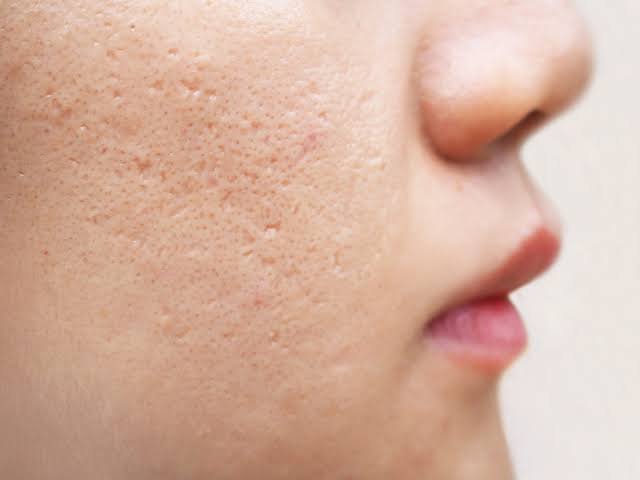
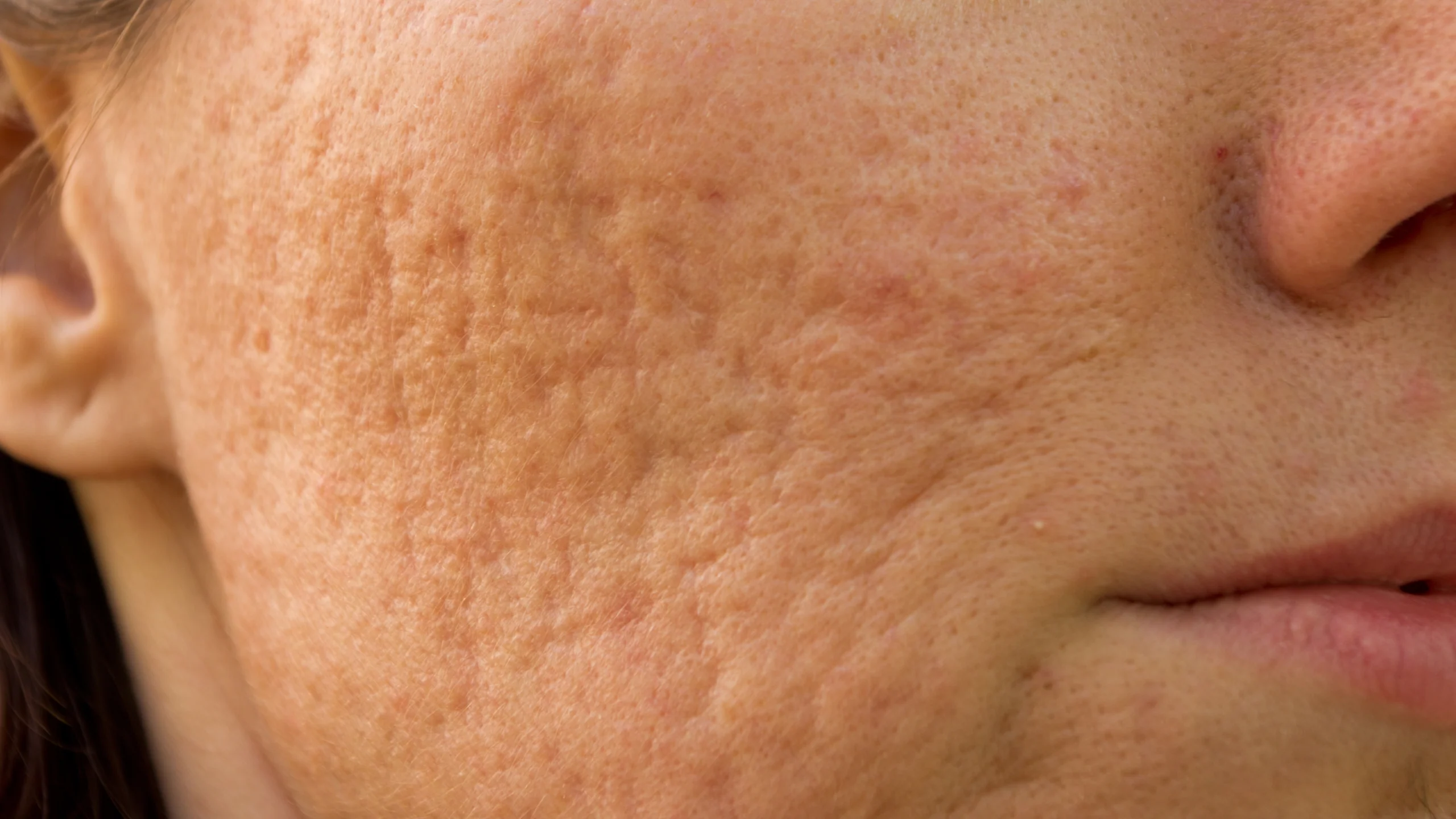
Boxcar and pore-type scarring of the cheek
TreatmentFocal TCA, 90%
ApproachScar floor for small boxcars, edge only for broad ones
About these photographs. Results are individual; yours may differ. Lighting and angle can change how scars look, so photographs are taken as consistently as possible.
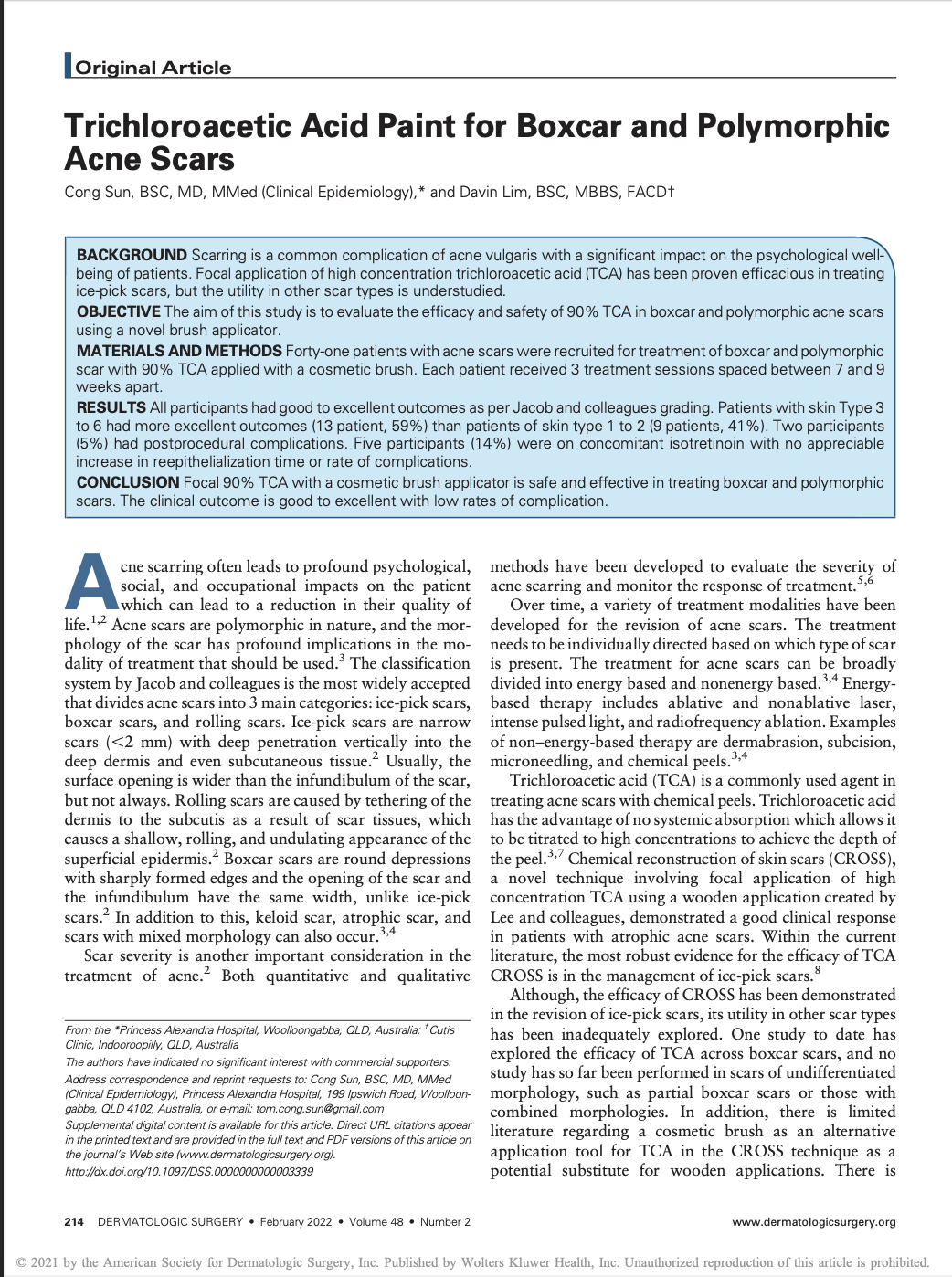
Trichloroacetic acid paint for boxcar and polymorphic acne scars
Cong Sun, Davin Lim
TCA CROSS had strong evidence for ice pick scars but little for boxcar or mixed scars. This study treated 41 patients with 90% TCA applied by fine brush — onto the base of small boxcars, the edge of broad ones, and only the sharp side of mixed scars.
100%Good or excellent outcomes among the 37 who completed
59%Excellent outcomes in skin types III–VI, vs 41% in I–II
5%Complication rate — both cases settled within 8 weeks
TCA by brush
Temporary PIH, type VI
Broad boxcar scars were treated with TCA to the margin only, to avoid delayed healing and scar extension.
A round or oval acne scar with steep edges and a flat floor, like a small crater. Shallow ones are 0.1–0.5 mm deep; deep ones go further, but stay within the dermis.
What is the difference between boxcar and ice pick scars?+
An ice pick scar is narrow and runs through the dermis into the fat. A boxcar scar has a flat floor that stays within the dermis, so lasers can reach it.
Are boxcar scars treatable?+
Yes. They are among the most responsive acne scars, because they sit within the layer that lasers and TCA treat.
5 questionsTreatment
What is the best treatment for boxcar scars?+
It depends on size and depth. Small boxcars are treated like ice picks, with TCA CROSS or a punch. Broad ones have TCA painted to the edge. Lasers — CO₂, erbium, fractional and non-ablative — treat the rest.
Can boxcar scars be treated in one session?+
Shallow boxcars in lighter skin often can, with fully ablative CO₂ or erbium. Darker skin needs 2–4 sessions to reach the same depth safely.
Why do I need more sessions with darker skin?+
Going too deep at once can cause darkening (post-inflammatory hyperpigmentation) or lightening (hypopigmentation). Splitting the depth across sessions gets the same result with much less risk.
Why not paint TCA over the whole scar?+
On broad scars, treating the whole floor risks slow healing and making the scar bigger. Painting only the edge softens the shadow without that risk.
Can I have treatment on isotretinoin?+
In my TCA study, patients on low-dose isotretinoin healed in the same time with no extra complications. Suitability for your plan is decided at consultation.
2 questionsRecovery & booking
How much downtime is there?+
About a week for TCA or a single fully ablative session; 3–5 days per session for fractional laser. Non-ablative laser is a day or two.
Can the assessment be done virtually?+
Yes. Your photographs are graded, each scar is mapped, and the number of sessions for your skin type is set out in a written report before we speak. Procedures are done in Brisbane or Sydney.
No questions match. Ask it in your consultation — book here.
Your photographs are graded, each boxcar scar is measured and mapped, and your written plan sets out the number of sessions for your skin type before we speak.
Content from Dr Lim's published work: Sun & Lim, Dermatol Surg 2022;48:214–18. Boxcar depth ranges follow Jacob et al. (J Am Acad Dermatol 2001). Skin layer illustration not to scale. General information only — not a substitute for individual assessment.
Have some questions?
Send a message and it will be answered personally. Form endpoint — to be wired in production
Follow the work
See the work before you book
Procedures, technique, before and afters, and the reasoning behind them — posted across three accounts, each with its own focus.
Feed placeholder — accounts and media to be wiredScroll sideways · slots are already the right shape, so nothing gets cropped when the real posts go in.