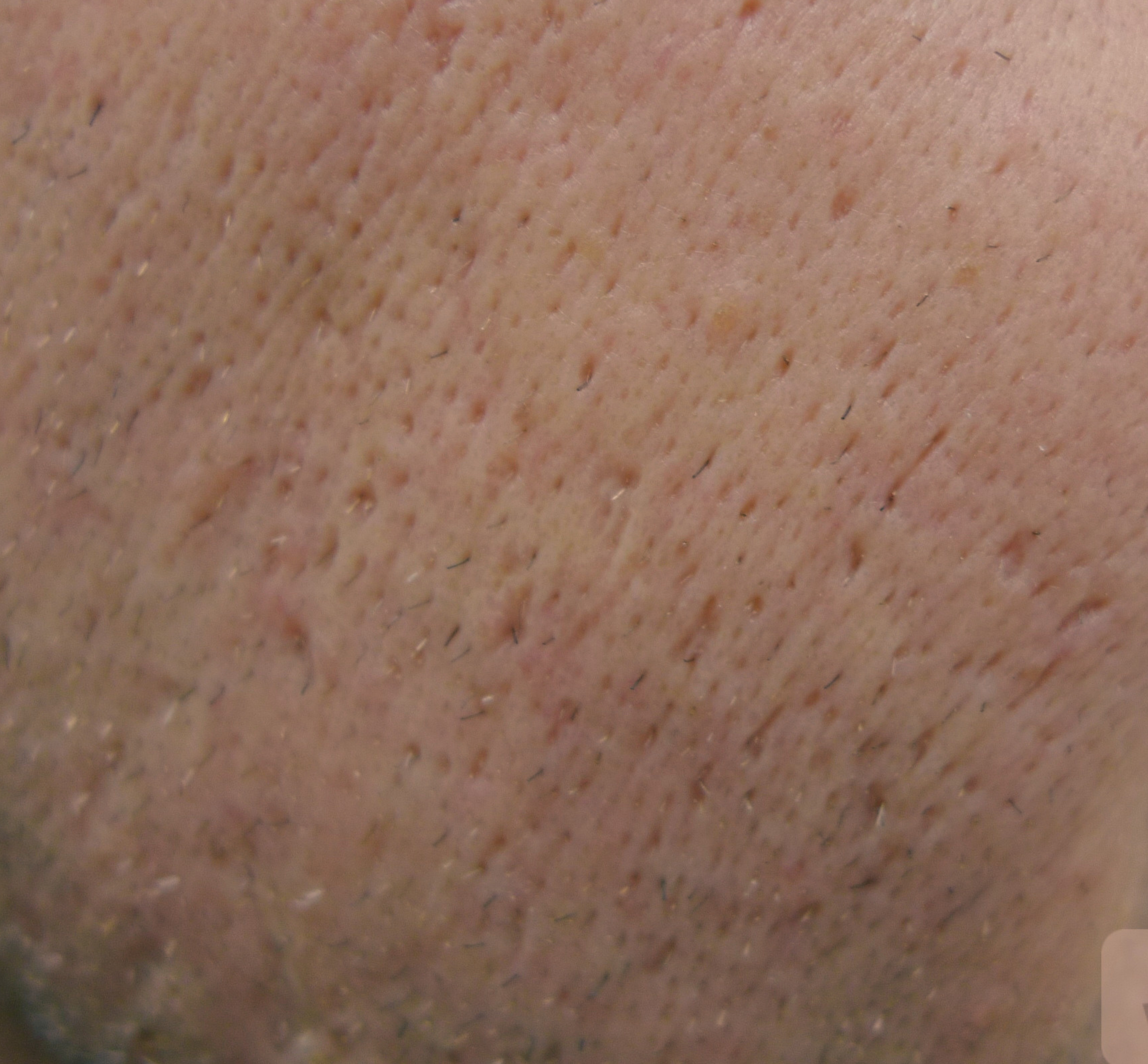
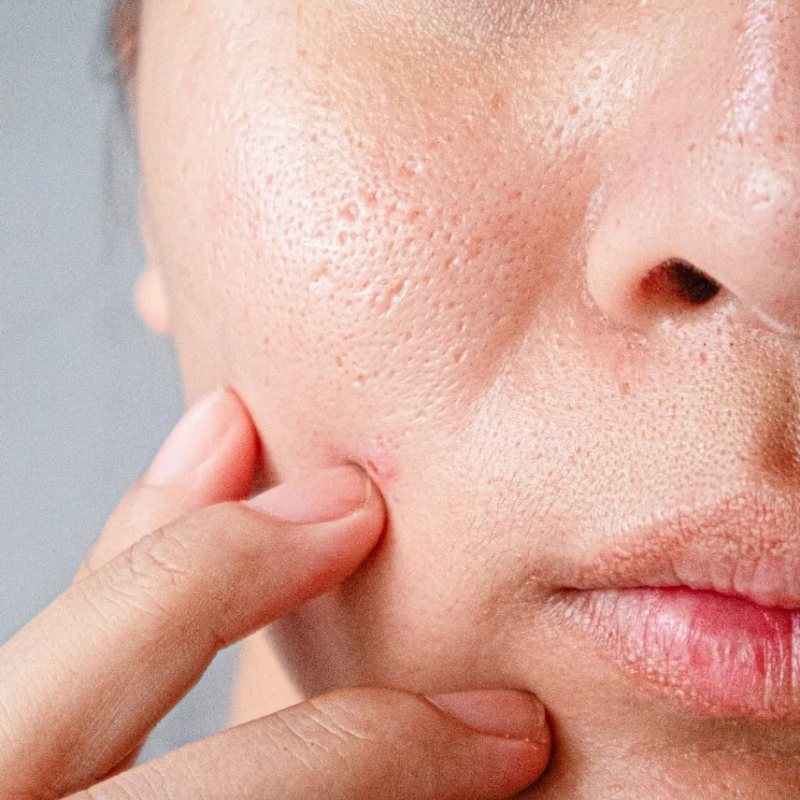
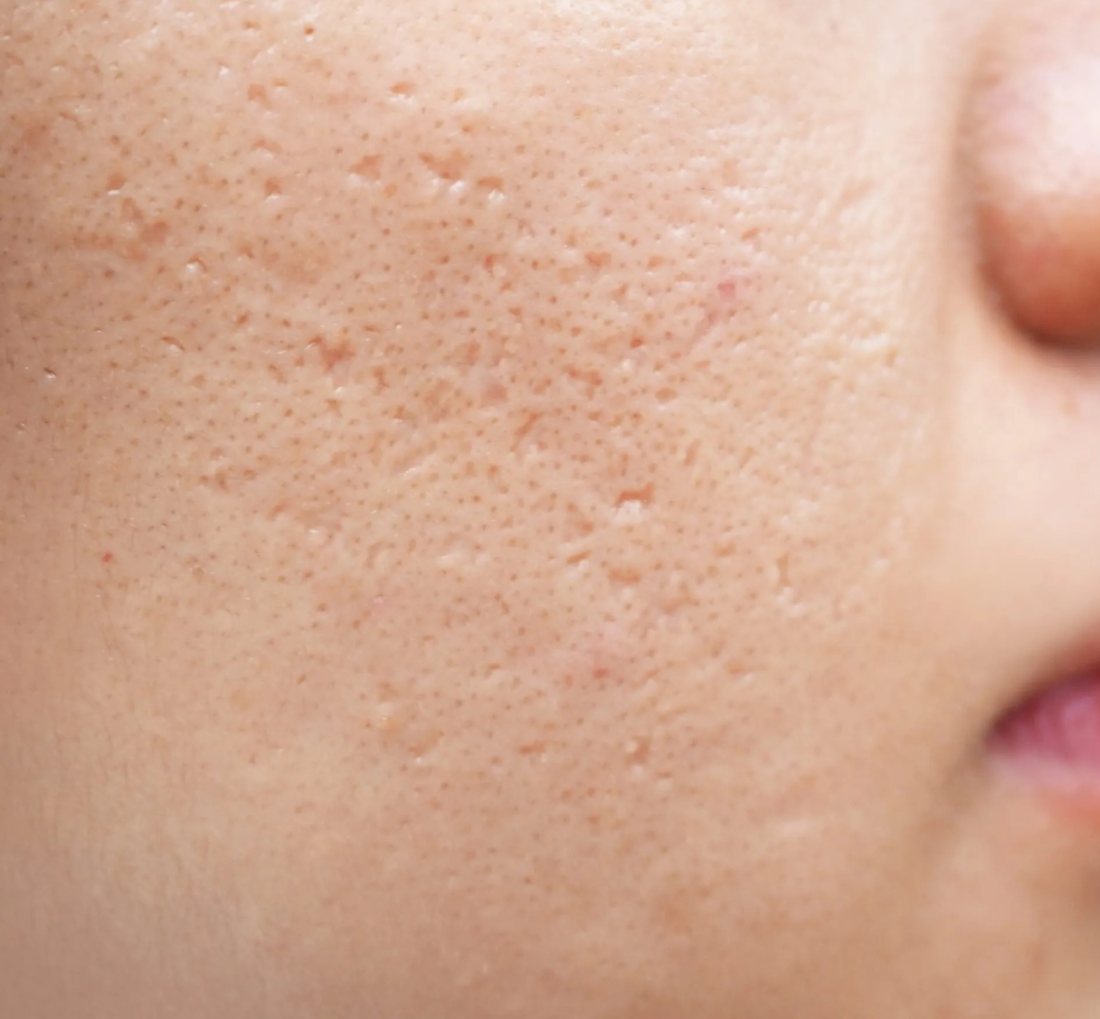
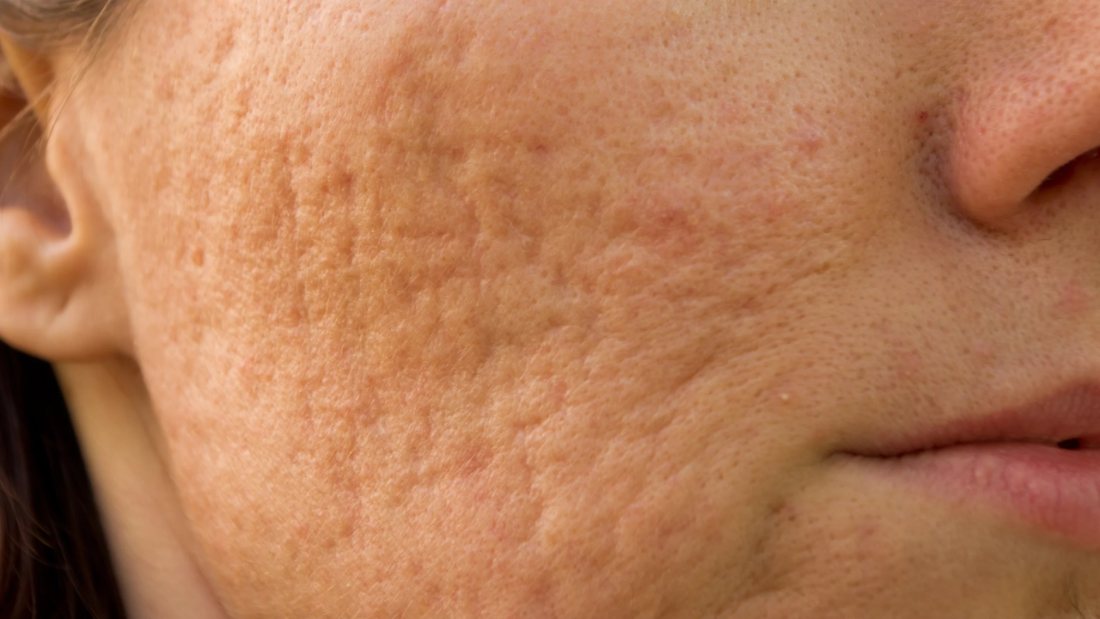
Ice pick scars are small at the surface and deep underneath. Most of the scar is out of sight, below where lasers can reach. That is why they so often stay put after several laser sessions — and why they respond to treatments that go all the way to the base.
Can ice pick scars be treated? Yes — just not by lasers alone.
Ice pick scars are among the most stubborn acne scars, but also among the most predictable to treat once they are matched to the right procedure. It comes down to depth.
01
They are deeper than they look.The opening is under 2 mm, but the tract runs through the dermis and often into the fat below it.
02
Lasers stop too early.Resurfacing lasers work within the dermis. They can soften the rim, but not the bottom of the scar.
03
The base has to be treated.Either rebuilt from below with focal TCA, or removed entirely with a precisely sized punch.
04
They are usually treated first.The deepest scars set the ceiling on your overall result, so they come first in any programme.
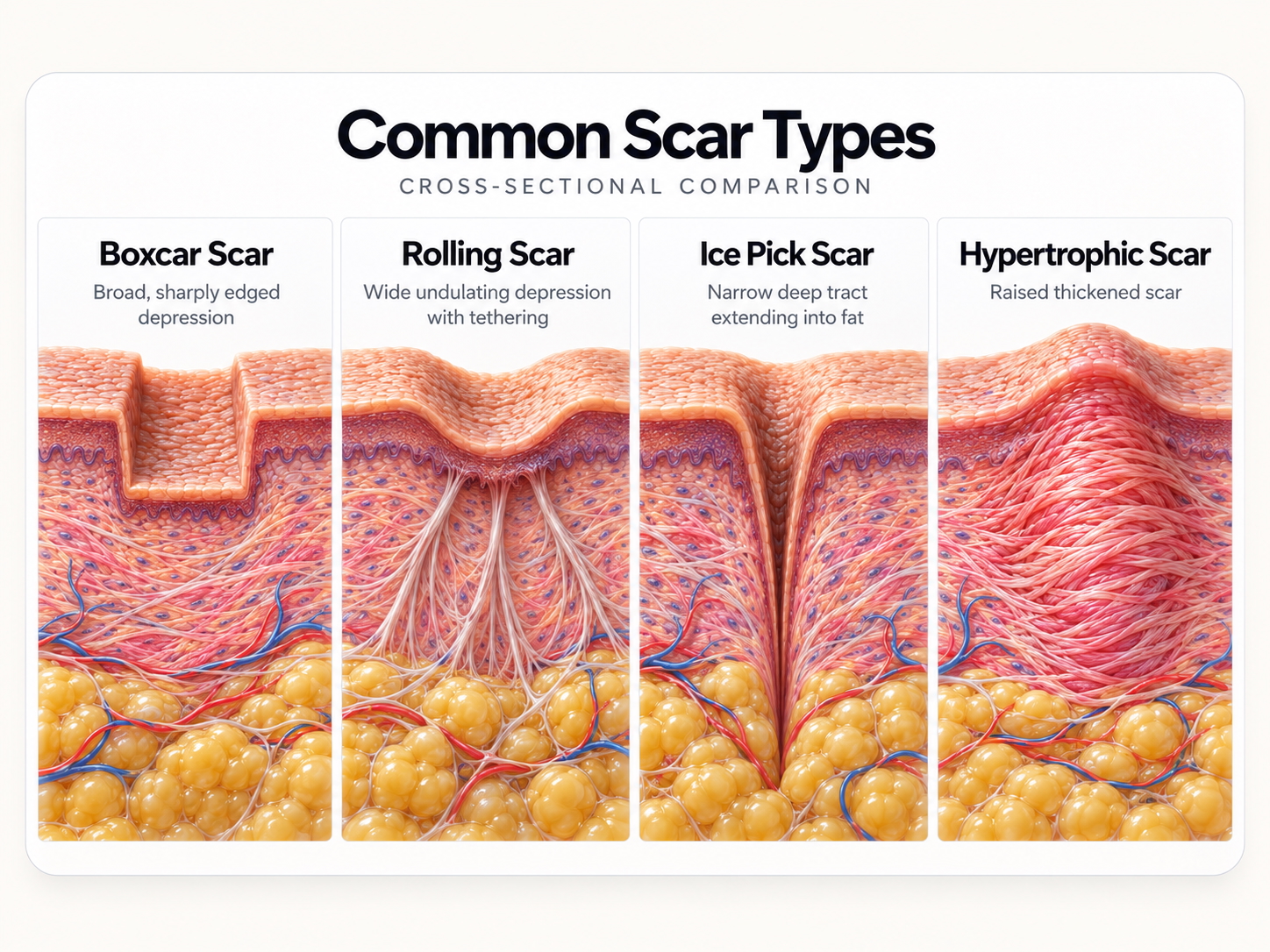
Ice pick scars (third from left) are the narrowest and the deepest of all acne scar types. Not to scale.
An ice pick scar running through the dermis into the subcutaneous fat — below the depth a resurfacing laser treats.
Depth is the whole story
An ice pick scar goes deeper than a laser can.
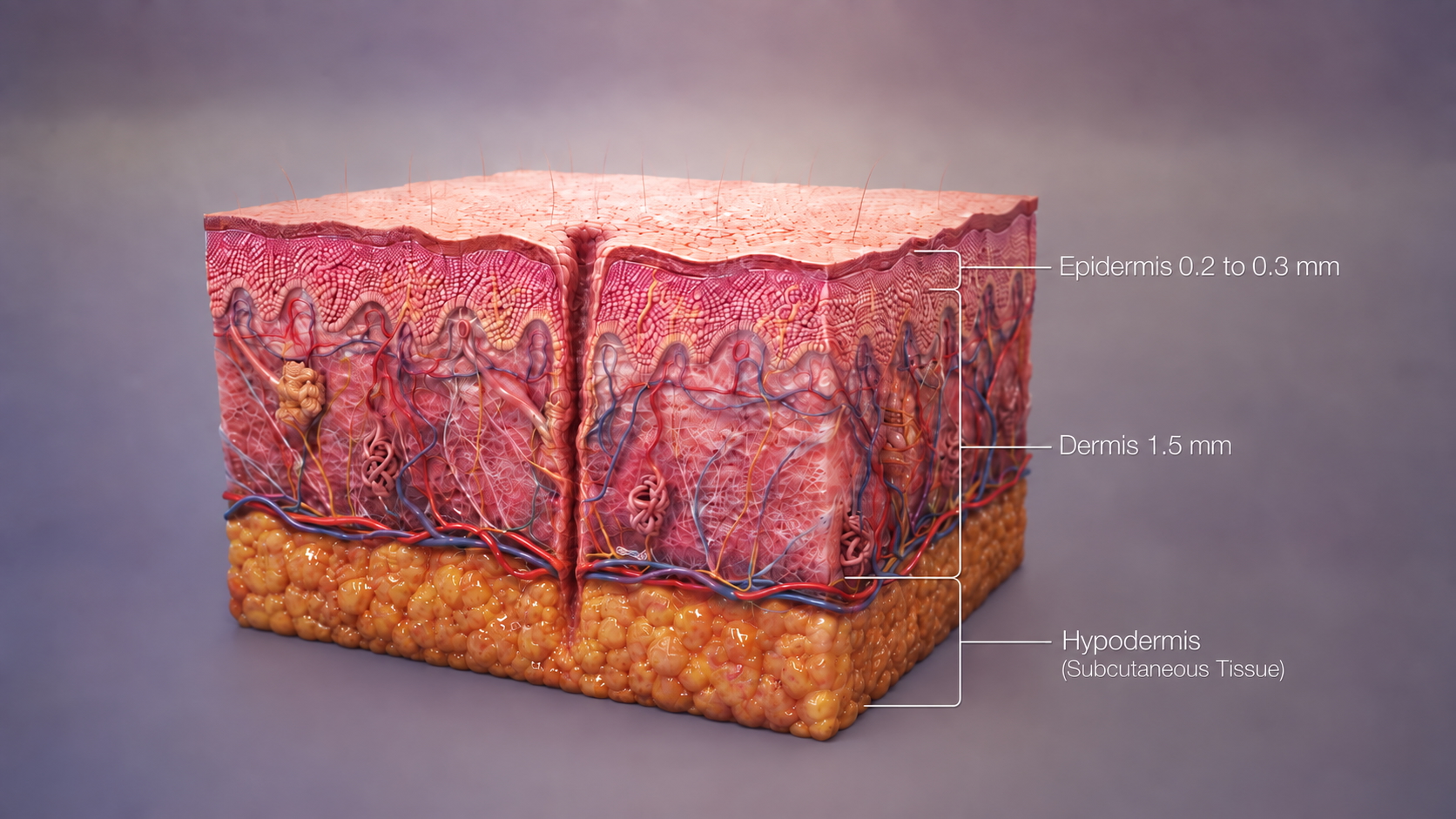
Your skin has three layers. The epidermis on top is 0.2–0.3 mm thick. Below it, the dermis — where collagen and scar tissue sit — is around 1.5 mm on the face. Below that is the subcutaneous fat.
A deep ice pick scar is a narrow tract running from the surface, through the full thickness of the dermis and into the fat. A resurfacing laser works in the dermis, so it stops short of the base, which stays untouched however many sessions you have.
What a laser does
Smooths the shoulders and surrounding texture. Useful as a finishing step, as it is in my published work.
What it cannot do
Reach, rebuild or remove the base of a tract sitting below the dermis.
What does work
TCA CROSS, placed down into the tract, or FUE punch excision, which takes the whole tract out.
123
1
The openingNarrow at the surface — often under 2 mm. This is the only part you see.
2
Through the dermisResurfacing lasers work in this layer. This is where their effect ends.
3
Base in the fatThe deepest part of the scar sits below the dermis, out of a laser's reach.
Illustration. Epidermis 0.2–0.3 mm, dermis about 1.5 mm, then subcutaneous fat. Layer thickness varies across the face.
Depth vs reach · indicativeOnly two treatments reach the base of a deep ice pick scar.
Indicative only. Depths vary with the device, settings and site. The point stands regardless: a treatment that stops in the dermis cannot change a scar whose base is in the fat.
Is it really an ice pick scar?
Ice pick scars are easy to mix up with three other things. The difference changes the treatment, so it is worth checking.
The side-light testShine a torch across your cheek from the side. An ice pick scar stays a dark pinpoint from every angle, because the base is too deep to light. A boxcar scar shows a floor.
You probably have more than one typeIce pick scars usually sit among boxcar and rolling scars. Your report maps each one, and the ice picks are almost always treated first.
Matching treatment to an ice pick scar
Because the problem is depth, the choice is simple: use something that reaches the base, and use lasers afterwards for the surrounding texture. The rest either stops short or treats a different problem.
TreatmentReaches the base?RoleDowntimeSessions
FUE punch excisionYes — removes itScar-matched punch (0.5–1.5 mm) takes out the whole tract. Heals on its own.Low1–2
TCA CROSSYes — rebuilds itHigh-strength acid placed down the tract triggers collagen to fill it from the base.Low–moderate2–4
Fractional CO₂ / erbiumNoSoftens the rim and blends texture after focal treatment. An adjunct.Moderate1–3
MicroneedlingNoMild texture only. Not a treatment for ice pick scars.Minimal—
SubcisionNot relevantReleases tethered rolling scars. Ice picks are not tethered.Moderate—
FillerNot relevantCannot lift a narrow, deep tract.Minimal—
Indicative — your plan is confirmed at consultation.
Six sessions of laser on ice pick scars is not a failed treatment. It is a mismatched one. The laser was never going to reach the bottom.
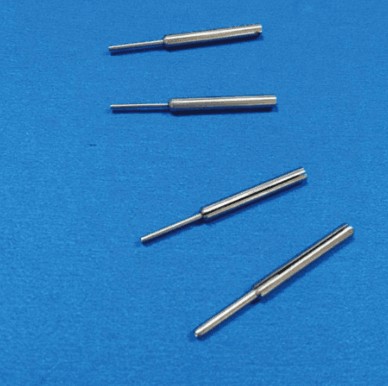
Standard biopsy punches only come in a few sizes and blunt after several scars. Follicular unit extraction (FUE) punches, borrowed from hair transplant surgery, come in 0.1 mm steps and stay sharp — so every scar gets an exact match.
0.5–1.5 mmPunch sizes, in 0.1 mm increments
34Procedures in the published series
0Cases of worsened depression or raised scarring
6 weeksTo the result shown in the paper
1
Mapping and scar selection
Each ice pick scar is marked and measured so the punch diameter matches the scar exactly.
2
Tumescent anaesthesia
Lidocaine with adrenaline is spread under the area with a blunt cannula, for comfort and minimal bleeding.
3
Punch excision
After ten minutes, the pre-selected punches remove each scar tract — through its full depth.
4
Healing on its own
Scars 1.5 mm or smaller heal by secondary intention — no stitches, and no new scar from the procedure.
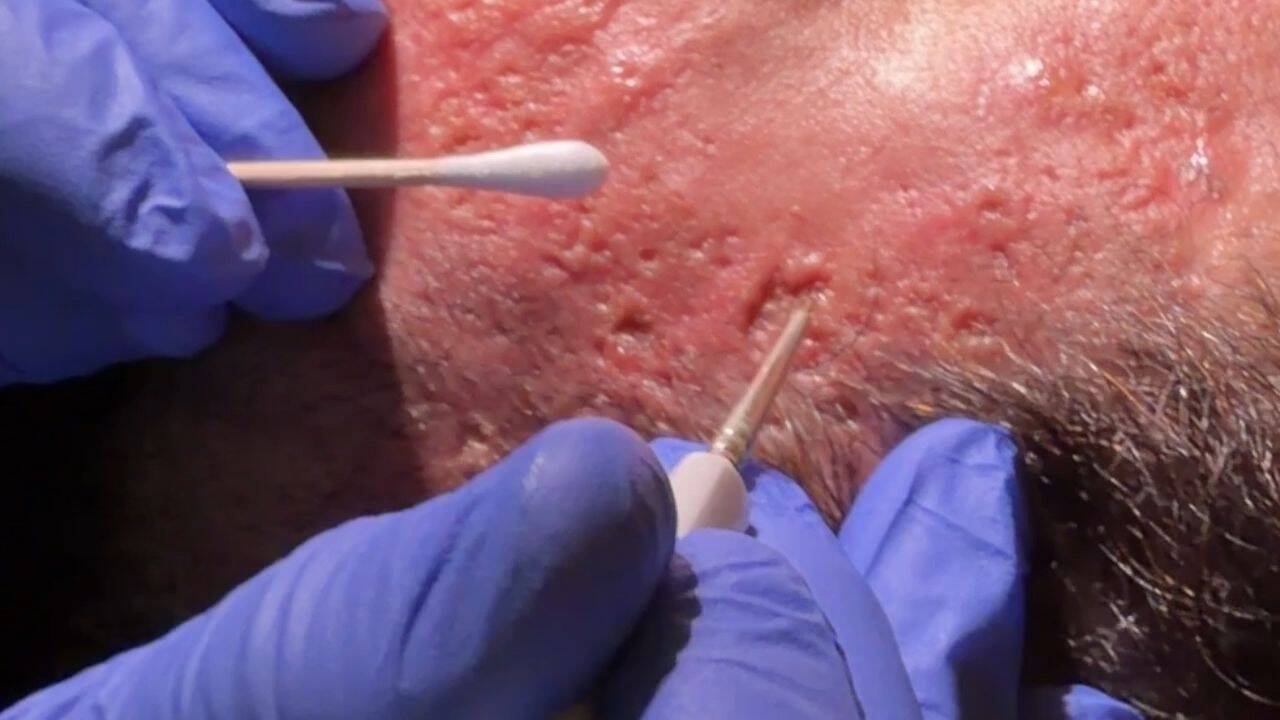
Intraoperative mapping and FUE punch excision (Lim & Hang, Fig. 2b).
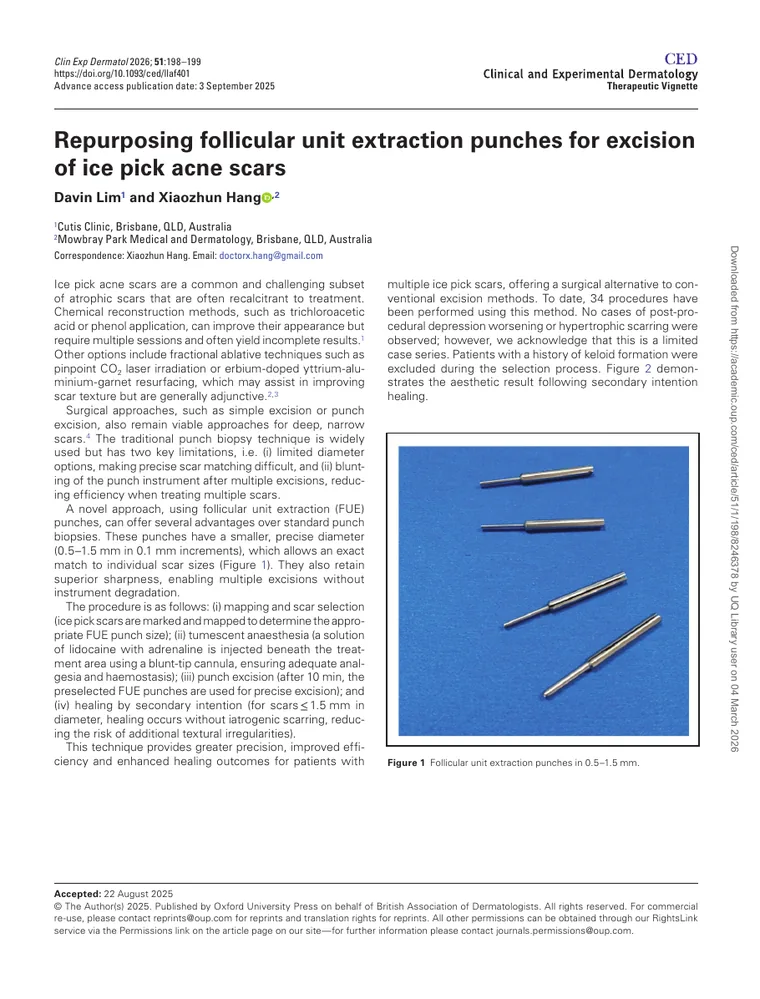
FUE punches in 0.5–1.5 mm (Lim & Hang, Fig. 1).
Patients with a history of keloid scarring are not suitable for this technique, and are identified at the assessment stage.
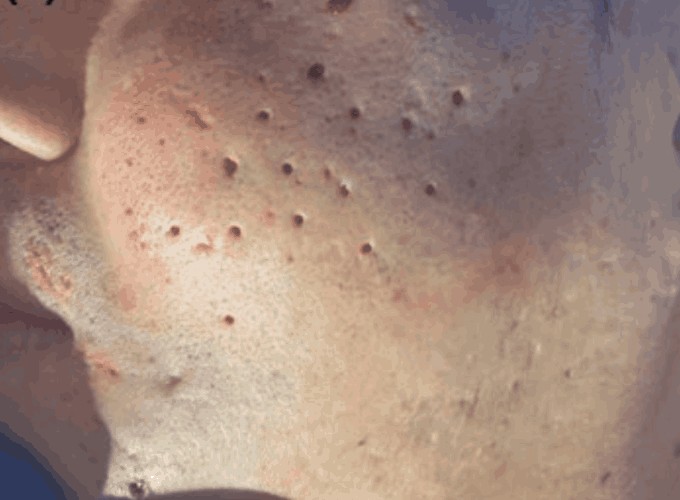
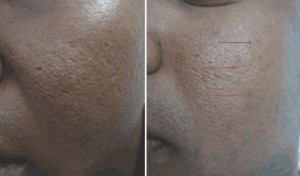
Isolated ice pick scars, FUE punch excision
From my published case · Clinical and Experimental Dermatology
TreatmentFUE punch excision, single session
HealingSecondary intention — no sutures
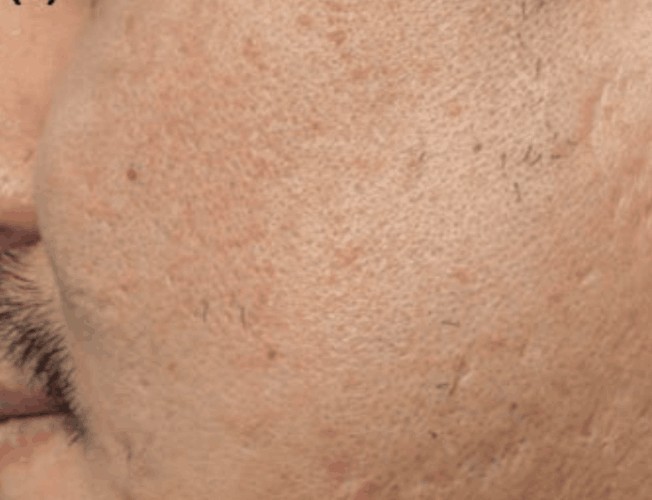
About these photographs. Published with written patient consent. Results are individual; yours may differ. Photographs from the paper are reproduced as printed.
Scars mapped and excised with size-matched FUE punches.
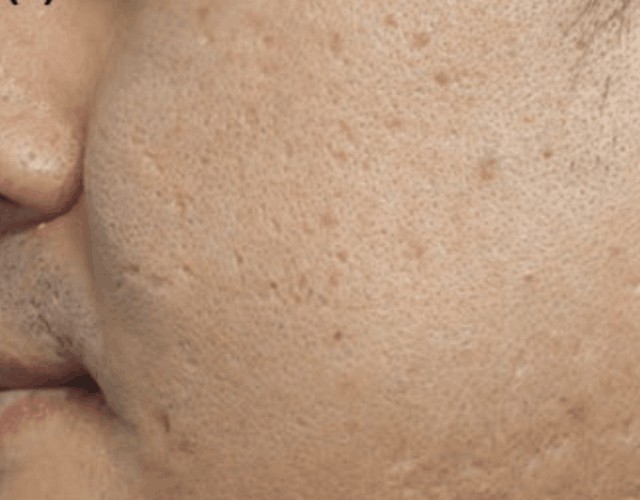
6 weeks
Healed by secondary intention, with no additional scarring.
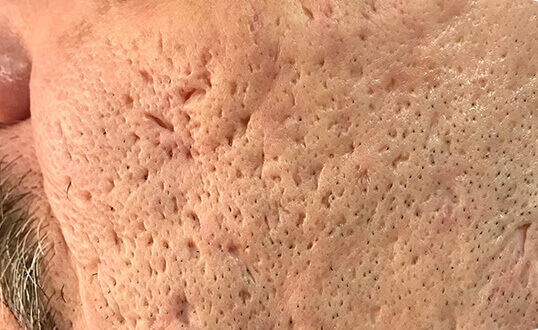
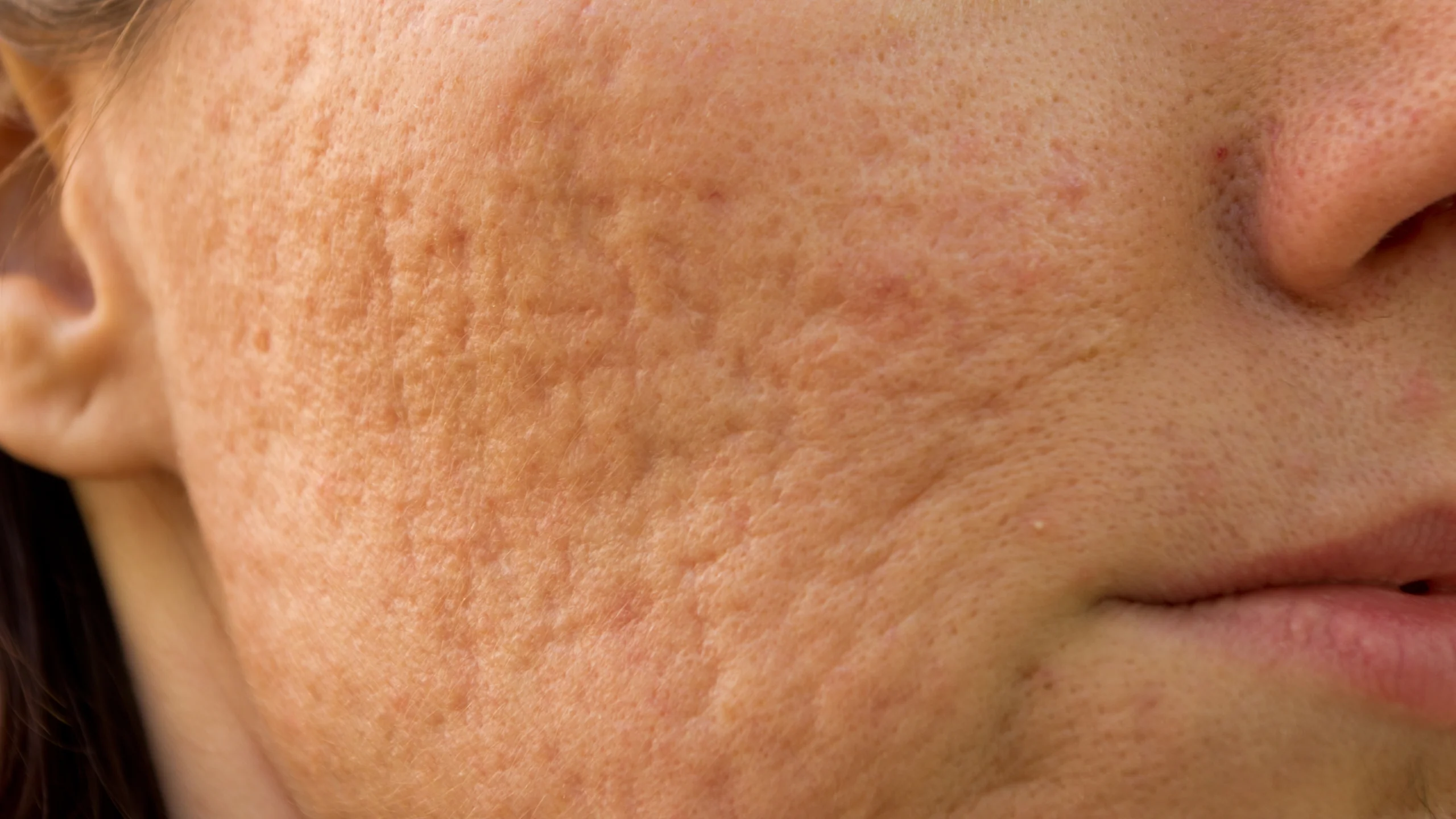
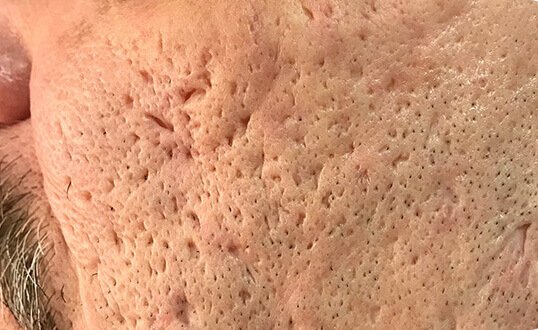
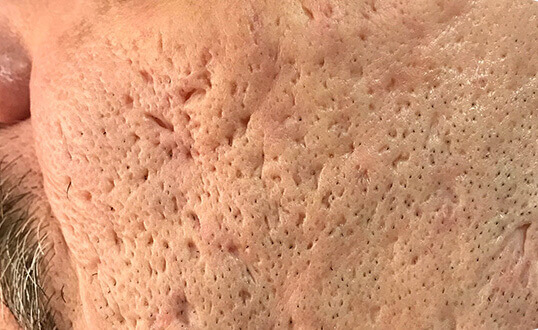
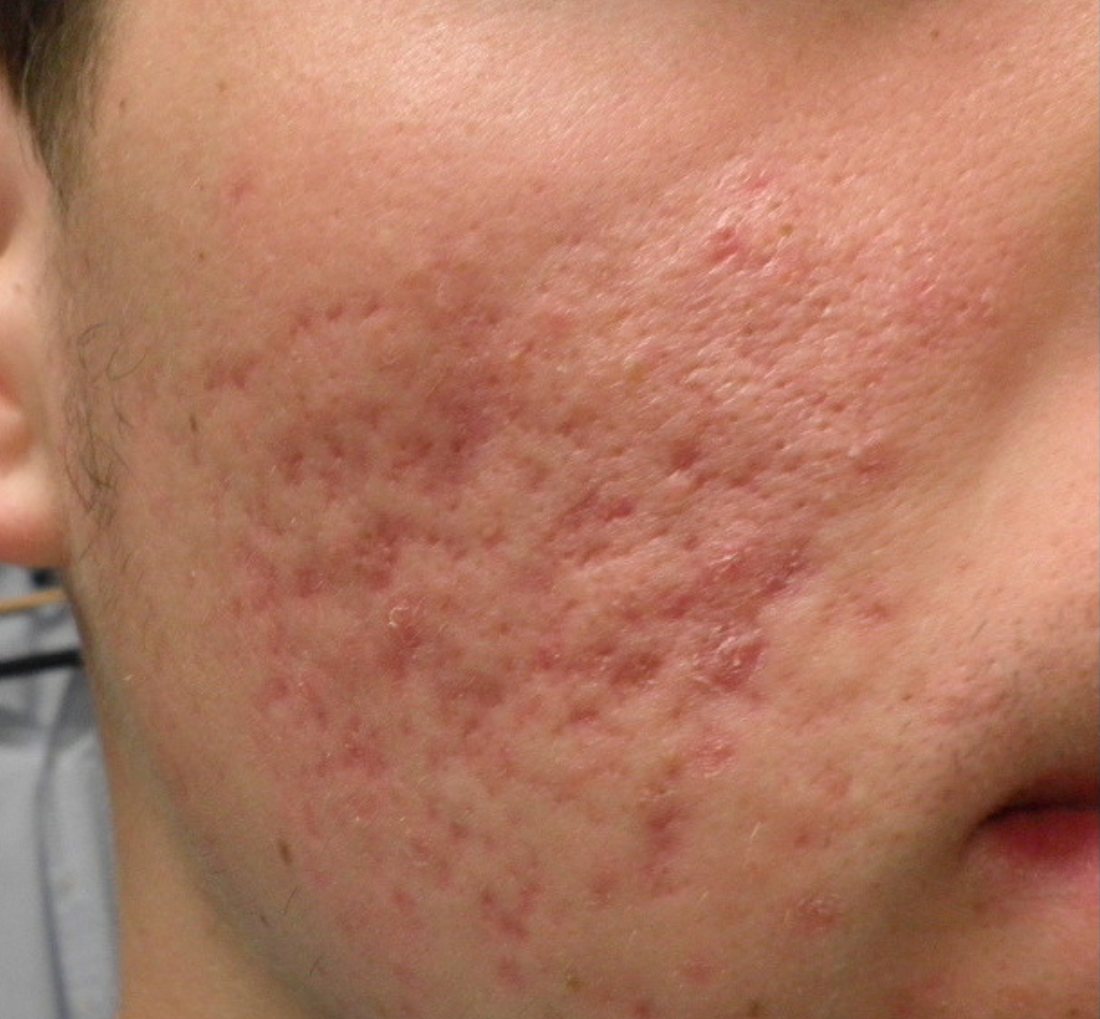
Dense ice pick and pore-type scarring — a candidate for focal TCA CROSS.
Deep ice pick scars suited to punch techniques.
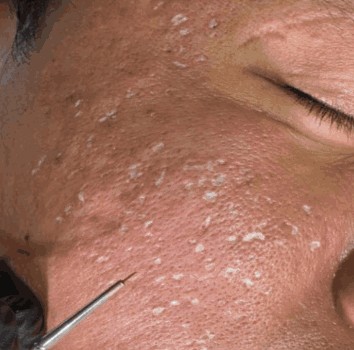
Frosting after 90% TCA applied with a fine brush (Sun & Lim, Fig. 2).
Downtime
Both focal treatments are low-downtime compared with resurfacing, because they treat the scar rather than the whole face.
FUE punch excision
About a weekSmall round wounds that close on their own. No stitches to remove.
TCA CROSS
5–7 daysWhite frosting on the day, then small dark crusts at each scar.
Adjunct laser
3–5 days + pinknessOnly if added. Red and swollen for a few days, then pink for 2–4 weeks.
Sun protection matters after every procedure, and most in darker skin.
Ice pick scars in darker skin
Focal treatments suit darker skin well because they treat only the scar, not the whole surface — so less skin is exposed to pigment risk.
Temporary darkening can still happen and is managed with pigment preparation beforehand and sun protection afterwards. In my TCA study the one case of darkening, in type VI skin, settled on its own within eight weeks.
59%of excellent outcomes in my published 90% TCA study were in skin types III–VI.Sun & Lim · Dermatologic Surgery 2022
Written by Dr Lim
The research behind this page
Both techniques on this page come from my own published work. Each paper is free to download.
Repurposing follicular unit extraction punches for excision of ice pick acne scars
Davin Lim, Xiaozhun Hang
Chemical reconstruction and fractional lasers help ice pick scars, but often need many sessions or play only a supporting role. This paper describes a surgical alternative using hair-transplant FUE punches to remove each scar exactly.
0.1 mmPunch size increments, for an exact match to each scar
34Procedures, with no worsened depressions or raised scars
≤1.5 mmScars heal on their own without adding new scarring
Before
Mapping & excision
6 weeks
Fractional ablative lasers may improve texture, but for ice pick scars they are generally adjunctive.
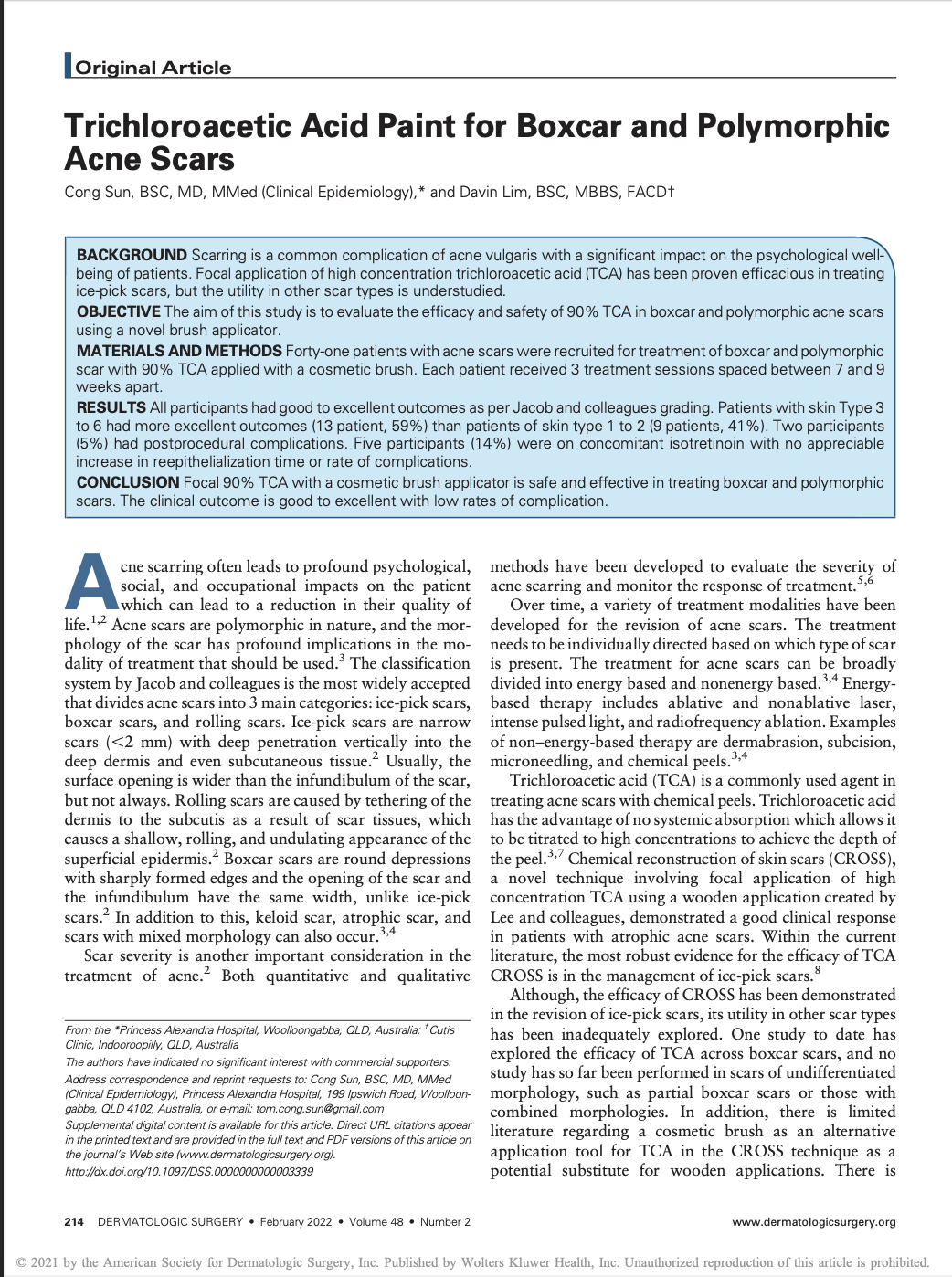
Trichloroacetic acid paint for boxcar and polymorphic acne scars
Cong Sun, Davin Lim
TCA CROSS already has its strongest evidence in ice pick scars. This study extended it to boxcar and mixed scars using 90% TCA and a fine brush, across 41 patients and three sessions.
100%Good or excellent outcomes among patients completing the study
5%Complication rate — both cases resolved within 8 weeks
14%On isotretinoin, with no increase in healing time
90% TCA by brush
Temporary PIH, type VI
Ice pick scars are narrow tracts reaching the deep dermis and even the subcutaneous tissue.
A narrow acne scar, usually under 2 mm across, that runs deep — through the dermis and often into the fat below. It looks like a small puncture in the skin.
Why didn't laser work on my ice pick scars?+
Resurfacing lasers work within the dermis. The base of a deep ice pick scar sits below it, so the laser softens the edge but never reaches the bottom. That is a matching problem, not a failure on your part.
How do I tell ice pick scars from enlarged pores?+
Pores are evenly spread and shallow. Ice pick scars are scattered, deeper and stay dark from every angle under side lighting. Your photographs are graded to confirm which is which.
5 questionsTreatment
What is the best treatment for ice pick scars?+
One that reaches the base: FUE punch excision for deep, isolated scars, or TCA CROSS for many smaller ones. Lasers are used afterwards to blend the surrounding texture.
What is FUE punch excision?+
Tiny punches designed for hair transplants, 0.5–1.5 mm in 0.1 mm steps, are used to remove each scar exactly. Scars 1.5 mm or smaller heal on their own without stitches.
Will punch excision leave a new scar?+
For scars 1.5 mm or smaller, healing by secondary intention left no additional scarring in my published series of 34 procedures.
How many TCA CROSS sessions will I need?+
Usually two to four, spaced six to eight weeks apart, because collagen rebuilds the tract gradually.
Can I have treatment on isotretinoin?+
In my TCA study, patients on low-dose isotretinoin healed in the same time with no extra complications. Suitability for your plan is decided at consultation.
3 questionsRecovery & booking
How much downtime is there?+
About a week for either focal treatment — small crusts or small healing dots. More if laser is added.
Is it safe for darker skin?+
Yes. Focal treatments suit darker skin well. Temporary darkening is possible and is managed with preparation and sun protection.
Can the assessment be done virtually?+
Yes. Your photographs are graded and each scar type is mapped in a written report before we speak. Procedures are done in Brisbane or Sydney.
No questions match. Ask it in your consultation — book here.
Content from Dr Lim's published work: Lim & Hang, Clin Exp Dermatol 2026;51:198–9, and Sun & Lim, Dermatol Surg 2022;48:214–18. Skin layer illustration not to scale. General information only — not a substitute for individual assessment.
Have some questions?
Send a message and it will be answered personally. Form endpoint — to be wired in production
Follow the work
See the work before you book
Procedures, technique, before and afters, and the reasoning behind them — posted across three accounts, each with its own focus.
Feed placeholder — accounts and media to be wiredScroll sideways · slots are already the right shape, so nothing gets cropped when the real posts go in.