Home›Treatments›Vascular laser
Treatment
Vascular laser
A laser that targets blood vessels and nothing else. It is used for facial redness, red marks left by acne, raised scars, birthmarks and thread veins — different problems that share one underlying feature: unwanted blood vessels close to the surface of the skin.
What it is, in two sentences
A vascular laser emits light at a wavelength absorbed almost exclusively by haemoglobin — the red pigment in blood. The vessel heats, collapses and is cleared away by the body, while the skin around it is left essentially untouched.
That selectivity is why one machine treats such different-looking conditions. A port wine stain, a rosacea flush and a red acne mark look nothing alike, but all three are excess blood vessels sitting where they should not be.
What brings you here?
Six distinct problems, six different answers — choose yours and go straight to it.Vascular laser treats six distinct problems, and the answers differ for each — how many sessions, what improvement to expect, and what it will not do.
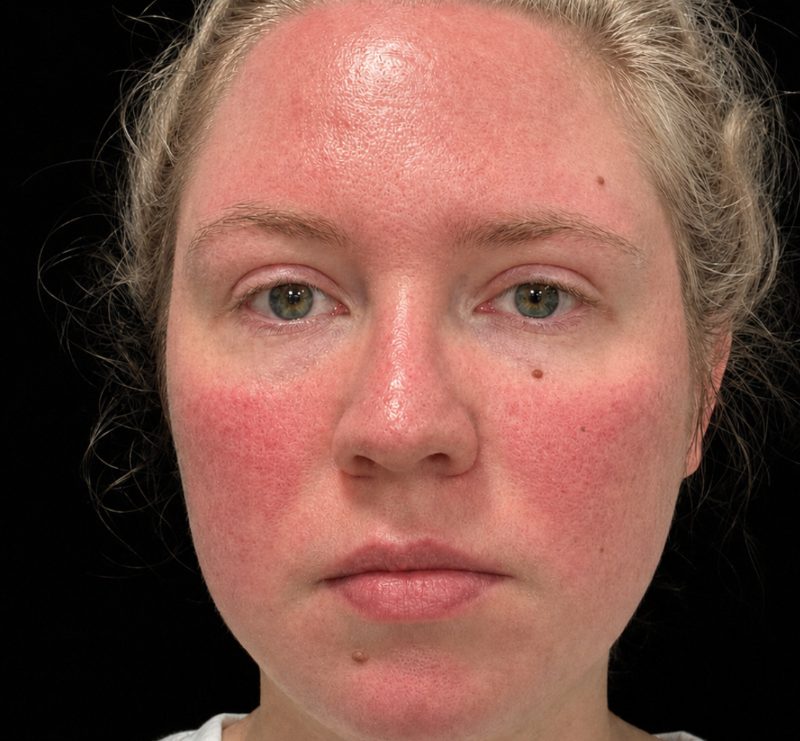 Rosacea & facial redness →Persistent flushing, background redness, visible vessels
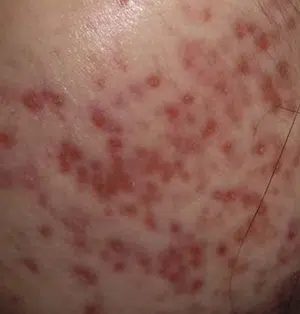 Red marks after acne →Flat pink or purple marks left behind — not scars
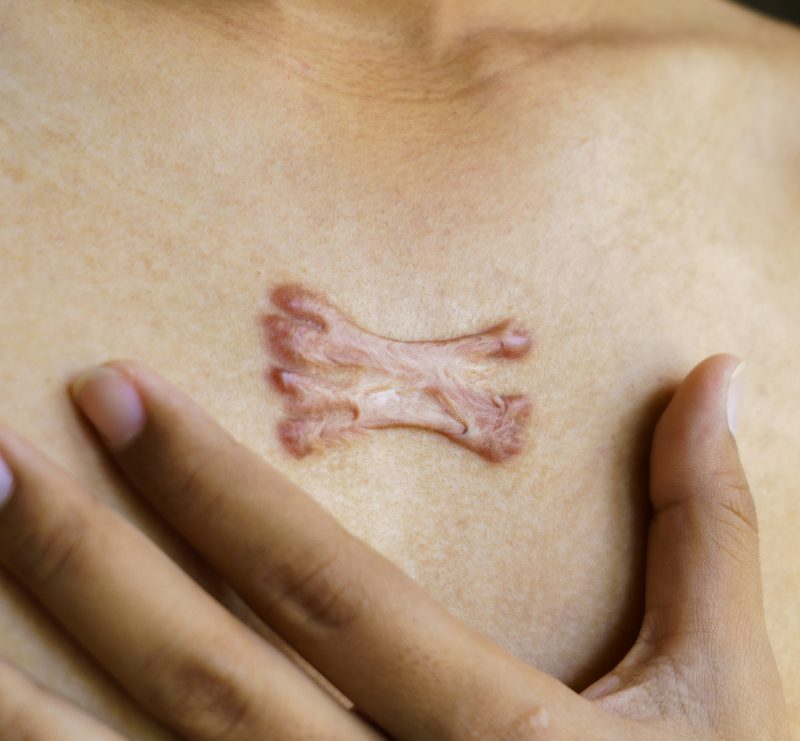 Raised & keloid scars →Thickened, red, itchy scars from acne or surgery
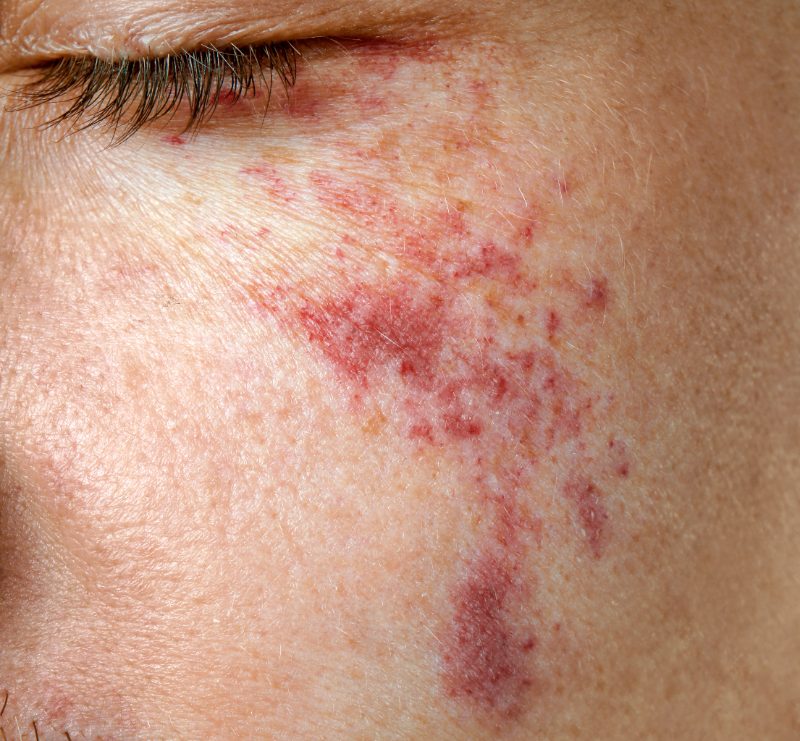 Birthmarks →Port wine stains and haemangiomas, including in babies
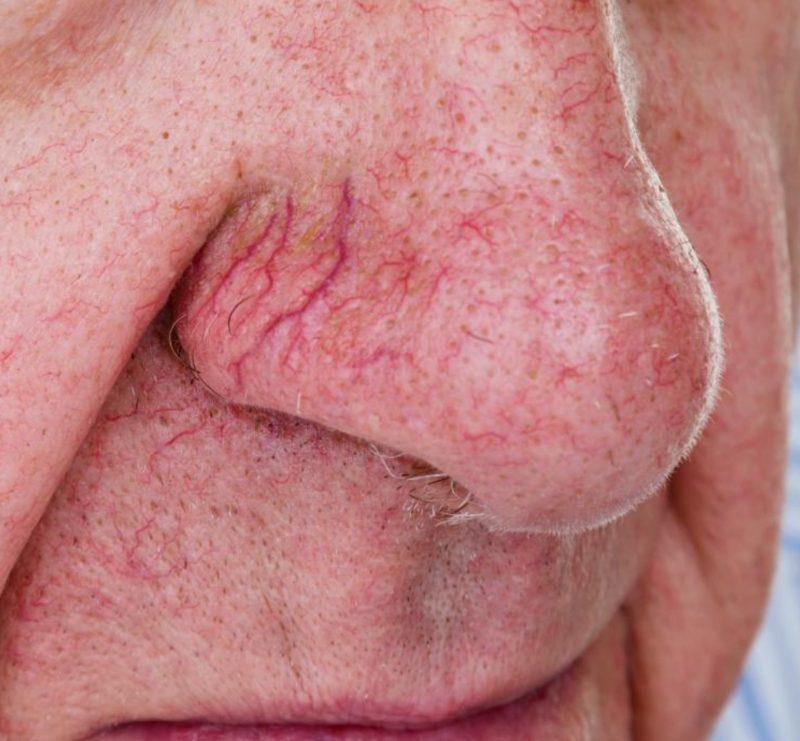 Thread veins & capillaries →Fine broken vessels on the nose, cheeks and chin
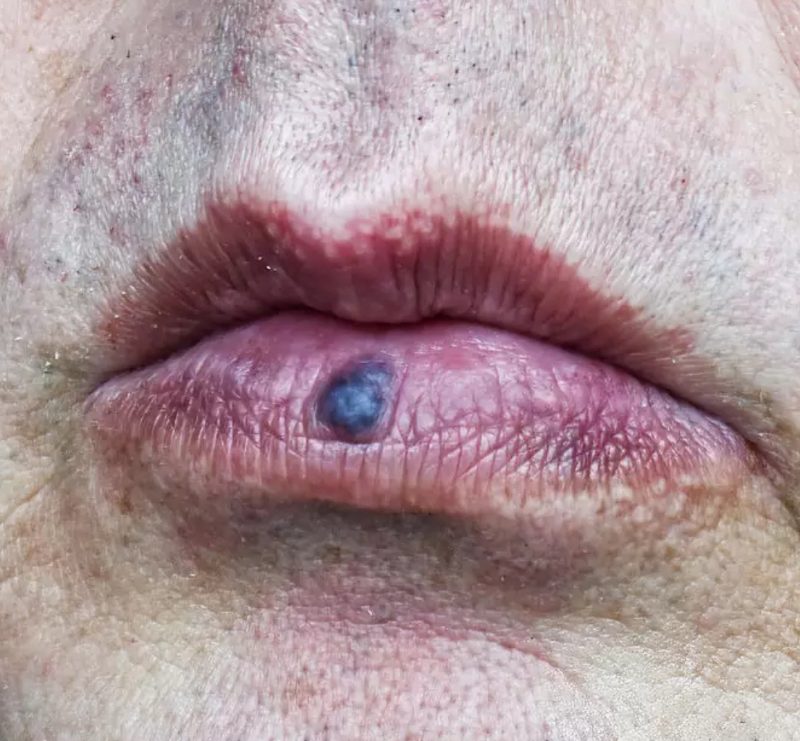 Other vascular marks →Spider naevi, angiomas, venous lakes, neck redness
Rosacea and facial redness
Vascular laser is the most effective treatment available for the fixed background redness and visible vessels of rosacea. It reduces the vessels that make the redness permanent, and most patients find their skin also becomes less reactive afterwards.
What it will not do: stop flushing. Transient waves of heat and colour are driven by nerve and trigger responses rather than by fixed vessels, and they respond to trigger management rather than laser. Laser also does nothing for the bumps and pustules of rosacea, which need medical therapy.
- Read more about rosacea →
Red marks after acne
The flat pink or purple marks left after a spot settles are not scars — they are dilated vessels where inflammation has been. Many fade on their own over six to twelve months, and it is worth knowing that before paying for treatment.
Laser is worth considering when marks have persisted beyond a year, when they are widespread enough to affect confidence, or when you want them cleared faster.
What it will not do: improve brown marks, which are pigment rather than blood vessels and need a different approach. Nor will it improve indented scars — if you can feel a dip with a fingertip, that is a scar and needs resurfacing or focal treatment instead.
- Red marks (PIE) →
- Brown marks (PIH) →
- Acne scarring →
Raised and keloid scars
Here the laser is doing something different. It is not removing a mark — it is targeting the vessels that feed an overactive scar, which reduces redness, itch and thickness over a course of treatment.
It is used alongside injections rather than instead of them. Intralesional corticosteroid remains the primary treatment for raised scars; laser adds to it, particularly for the redness and the itch, which patients often find the most distressing part.
What it will not do: flatten an established keloid on its own. Anyone offering laser as a standalone cure for keloid scarring is overstating what it does.
- Raised & keloid scars →
- Intralesional injections →
Vascular birthmarks
Port wine stains and some haemangiomas respond to vascular laser, and this is the longest-established use of the technology. Expectations here are different from every other section on this page: treatment is a long course measured in years rather than months, and the goal is substantial lightening rather than complete clearance.
Treatment in babies and young children is a different experience from the adult treatment described further down this page — different comfort measures, different session planning, and sometimes general anaesthetic for larger areas. Please read our dedicated page rather than the general procedure section below. Vascular birthmarks in children →
What it will not do: remove a port wine stain completely in most cases. Lightening is usually substantial and worthwhile; erasure is uncommon, and stains tend to re-darken slowly over years, so ongoing maintenance is normal rather than a sign of failure.
- Vascular birthmarks →
Thread veins and broken capillaries
Individual visible vessels on the nose, cheeks and chin are the most satisfying thing this laser does. Treatment is quick, targeted, and results are usually visible within a fortnight.
What it will not do: stop new vessels forming. Treated vessels are gone permanently, but the tendency that produced them remains — which is why we also look for an underlying cause such as rosacea or sun damage rather than simply treating and rebooking.
- Facial telangiectasia →
Other vascular marks
The same laser treats a range of smaller vascular lesions: spider naevi, cherry angiomas, venous lakes on the lip, and the mottled redness of sun-damaged skin on the neck and chest. Most need one to three sessions.
Before treating any new or changing lesion, we examine it properly. Not everything red is vascular, and a lesion that has appeared recently, changed, or bleeds should be assessed before it is lasered rather than after.
- Skin lesion assessment →
Everything below applies to all six
The procedure itself is the same regardless of what is being treated — only the settings and the number of sessions change.
Which laser, and why it matters
“Vascular laser” is a family rather than a single machine. Vessel depth and size determine which member of the family is used, and using the wrong one is a common reason for a disappointing result elsewhere.
| Type | Reaches | Typically used for |
|---|---|---|
| Pulsed dye (595 nm) | Superficial to mid-depth | Rosacea, red acne marks, port wine stains, raised scars — the workhorse for most of this page |
| KTP (532 nm) | Very superficial | Fine individual vessels, small telangiectasia |
| Nd:YAG (1064 nm) | Deeper | Larger or deeper vessels, resistant birthmarks, venous lakes |
I hold more than one platform, which means the device is chosen for your vessel rather than your vessel being treated with whatever is in the room. There is a full explanation of each wavelength and when I reach for it at the bottom of this page.
What happens on the day
- Assessment
The area is examined, the correct device and settings selected, and a test pulse placed in an inconspicuous spot if you have not been treated before.
- Eye protection
Goggles for you, for me, and for anyone else in the room. Non-negotiable.
- Treatment
Pulses delivered across the area. Integrated cooling fires immediately before and after each pulse.
- Time
Five to thirty minutes depending on the area. A few thread veins take minutes; a full face takes longer.
- Afterwards
Cool packs, sunscreen, and written aftercare. You leave and carry on with your day.
Comfort
Most people describe it as a rapid series of hot flicks, like a rubber band snapped against the skin, each lasting a fraction of a second. The integrated cooling makes a substantial difference and most adults need no anaesthetic at all.
Numbing cream is available if you would prefer it, applied 30–45 minutes beforehand. For children and for larger areas, comfort is planned separately and discussed before booking.
Recovery, at a glance
Five stages, in order. Most people are back to normal within two days.Gentler settings mean little or no bruising and more sessions. Higher settings mean fewer sessions and visible bruising for one to two weeks. Neither is wrong — but if you have a wedding in a fortnight, that is a conversation to have before treatment rather than after.
Risks
| Effect | Frequency | Notes |
|---|---|---|
| Redness and swelling | Expected | Settles over 24–48 hours. |
| Bruising | Setting-dependent | Predictable and discussed beforehand. |
| Temporary pigment change | Uncommon | More likely in deeper skin tones and in recently tanned skin — the main reason for conservative settings and test spots. |
| Crusting | Uncommon | Small crusts with higher settings. Leave them alone. |
| Blistering | Rare | Managed with dressings; usually heals without a mark. |
| Scarring | Very rare | Almost always associated with picking crusts or with sun exposure during healing. |
| Incomplete response | Varies | Depends entirely on what is being treated — see your section above. |
Recent sun exposure, fake tan or a solarium tan substantially raises the risk of pigment change and burns. If you have been in the sun, tell us — we will reschedule rather than treat. This applies to fake tan as much as to real tanning.
Who is and isn’t a candidate
Suitable for most adults with any of the conditions above, and for children with birthmarks under appropriate arrangements.
Tell me beforehand if you have a history of cold sores in the area, as laser has the potential to bring cold sores out. A simple antiviral treatment is the solution.
Also tell me if you are pregnant, take medication that increases light sensitivity, have recently used oral retinoid therapy, have a bleeding disorder or take blood thinners, or have a tan.
Don’t come in for laser the day before a big event. That is common sense.
Common questions
Why is one page covering so many different conditions?
How much does it cost?
Who performs it?
How many sessions will I need?
Will it bruise?
Is it safe in darker skin?
Do the vessels come back?
Is this the same as IPL?

The vascular lasers I use, and why I choose between them
Dr Davin Lim · Dermatologist · The Skin Hospital, Sydney — Laser, Procedural and Anaesthetic Division
Patients often assume a laser is a laser. It is a reasonable assumption and an expensive one. What actually matters is the wavelength — the colour of the light — because that determines what the light is absorbed by and how deeply it travels before it gets there. For blood vessels there are three wavelengths worth owning, and I use them in different situations.
532 nm — the fine-detail wavelength
Green light at 532 nm is absorbed very strongly by haemoglobin, which makes it extremely efficient. The trade-off is that it does not travel far: it works in the top fraction of a millimetre of skin. That makes it my choice for the fine, discrete, superficial vessels people notice most in the mirror — a thread vein at the edge of the nostril, a cluster of capillaries on the cheek, a small cherry angioma. I can treat these vessel by vessel with a small spot and almost surgical precision. Because 532 nm is also well absorbed by melanin, I am more conservative with it in tanned or deeper skin, and I will often test a small area first.
595 nm pulsed dye — the workhorse
The 595 nm pulsed dye laser is the most studied vascular laser in dermatology, and for most of the conditions on this page it is the one I reach for. It sits at a useful compromise: still strongly absorbed by blood, but travelling deeper than 532 nm and less troubled by surface pigment. It is what I use for the diffuse background redness of rosacea, for red marks left by acne, for port wine stains, and for the redness and itch of raised and keloid scars. It is also the gentlest of the three in terms of how the treatment feels, and it gives me the widest range of settings — from a light pass with no bruising at all, to a purpuric setting that deliberately bruises and clears stubborn vessels in fewer sessions.
1064 nm Nd:YAG — the deep-reaching wavelength
At 1064 nm, absorption by haemoglobin is far weaker — but the light penetrates much further, and it largely ignores surface pigment. That combination makes it the safest option in deeply pigmented skin and the only real option for vessels that sit too deep for the other two: larger blue vessels around the eye and temple, a venous lake on the lip, a leg vein, or a resistant birthmark that has stopped responding. Because it is less selective, it demands more energy and more caution — it is the wavelength with the least margin for error, and it is not one to be used casually.
Why more than one matters
Most vascular problems are a mixture: superficial capillaries over a background flush, with a few deeper vessels running through. Treating all of that with a single device means part of it is treated well and the rest is treated approximately. Holding more than one platform lets me match the wavelength to the vessel in front of me — and, just as often, to your skin tone. That is the whole argument for device choice, and it is the single biggest reason results differ between clinics using nominally the same treatment.
— Dr Davin Lim, Consultant Dermatologist
Conditions this treats
Related treatments
- Intralesional injections →
- Fractional CO₂ laser →
- Picosecond laser →
- Topical pigment therapy →
- All treatments →
Book a consultation
Assessment, diagnosis and a written plan — including whether vascular laser is right for you and whether a Medicare rebate applies.
Book a virtual consultation$690 – $1,190 per treatment
 Some cases partially covered
Have some questions?
Send a message and it will be answered personally. Form endpoint — to be wired in production
See the work before you book
Procedures, technique, before and afters, and the reasoning behind them — posted across three accounts, each with its own focus.