Does pico laser beat the cream for melasma?
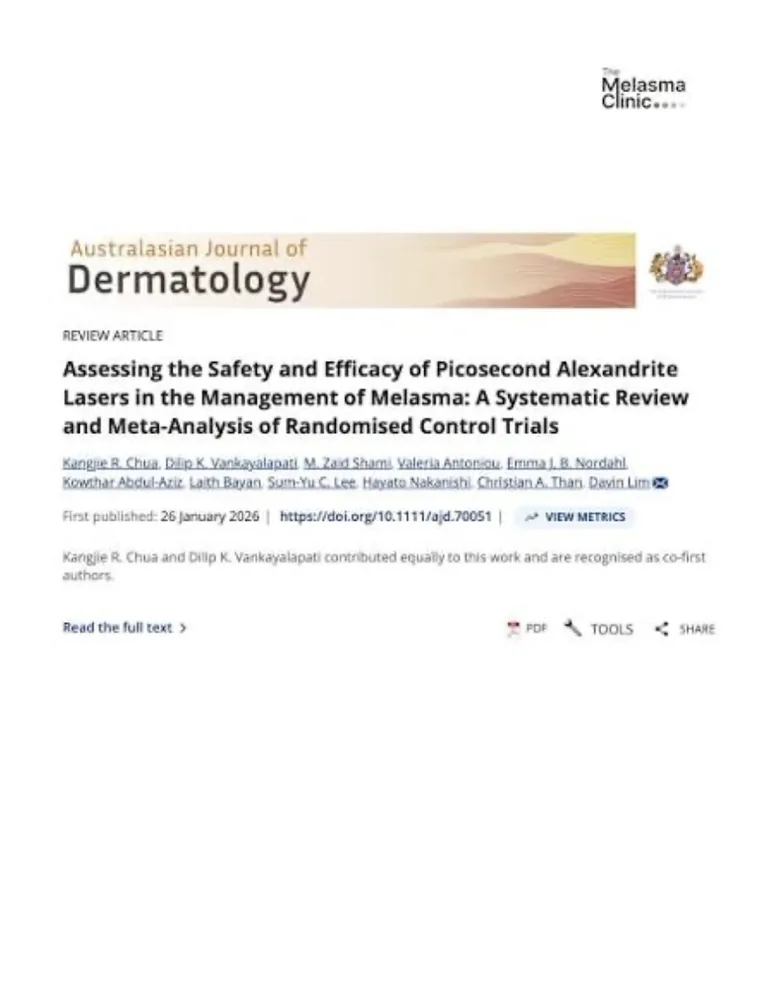
Assessing the Safety and Efficacy of Picosecond Alexandrite Lasers in the Management of Melasma: A Systematic Review and Meta-Analysis of Randomised Control Trials
Pooling every randomised trial that has been done, the standard prescription cream reduced melasma more than the picosecond alexandrite laser did — and the laser caused more pigment rebound than topical treatment.
Four numbers worth knowing
What we found
The cream outperformed the laser.
Across the five trials, triple combination cream — the standard prescription topical for melasma — achieved greater improvement in melasma severity scores than the 755 nm picosecond alexandrite laser.
The laser caused more pigment rebound than topical treatment.
Post-inflammatory hyperpigmentation occurred more frequently with the laser than with topical therapy. In melasma that is a particularly unwelcome side effect, because the problem being treated is pigment in the first place.
Against other lasers, it was no worse.
Compared with Q-switched lasers, there was no difference in the rate of post-inflammatory hyperpigmentation. The pigment-rebound problem is not specific to picosecond technology.
Nothing more serious appeared.
No cases of hypopigmentation and no infections were documented in any of the five trials. The adverse events that did occur were modest.
The certainty of all this is low.
Five trials and 139 patients is a small evidence base, and the authors grade the certainty accordingly. This is a direction of travel rather than a settled verdict.
There is still a case for the laser in refractory melasma.
Modest adverse event rates mean the laser may still have a place where creams have genuinely been tried and have not worked — which is a narrower indication than how it is often used.
Nobody has tested whether either lasts.
The review's closing call is for larger trials with extended follow-up examining durability and recurrence. Melasma's defining feature is that it comes back, and none of these trials ran long enough to speak to that.
What this means for you
Topicals first, and properly
On the evidence assembled here, the cream outperformed the laser. If you are being offered laser for melasma before a prescription topical regimen has been tried and given time to work, ask why.
“Refractory” has to mean something
The case for laser rests on melasma that has resisted proper treatment. Several weeks of an over-the-counter product is not a failed course of treatment.
Rebound pigment is the specific risk
Laser for melasma carries a higher rate of post-inflammatory hyperpigmentation than creams do. Going darker after a treatment aimed at lightening is the outcome to understand before you consent.
Sun protection is doing more work than either
Neither arm of any of these trials works without it. Melasma is driven by ultraviolet and visible light, and photoprotection is what holds any result you achieve.
Ask what happens in a year
Nobody can answer this from the current evidence, and any clinician who gives you a confident number about durability is going beyond what has been studied.
Why this matters
Melasma is a chronic, relapsing pigment disorder, and it is genuinely difficult to treat. The standard first-line treatment is a triple combination prescription cream, used under supervision because it cannot be used indefinitely.
Lasers are appealing here for obvious reasons: they are quick, they are visible as treatment, and picosecond devices in particular arrived with a reputation for being gentler than the Q-switched lasers before them. Melasma clinics around the world adopted them rapidly.
What had not been done was to pool the randomised trials and ask whether the laser actually beats the cream. This review did that, and the answer is not the one the enthusiasm would predict.
The honest reading
This is not a paper saying picosecond lasers do not work for melasma. It is a paper saying that, on the small body of randomised evidence available, they have not beaten a cream — and that where a laser is used, pigment rebound is a realistic risk that topical treatment does not carry to the same degree.
Who was studied
A systematic review and meta-analysis conducted to PRISMA guidelines, searching multiple databases up to 10 April 2025 for randomised controlled trials in adults with melasma that measured outcomes using the Melasma Area and Severity Index or its modified version.
- Trials included
- 5
- Patients
- 139
- Search cut-off
- 10 April 2025
- Design
- Randomised trials only
- Outcome measure
- MASI / mMASI
What this study cannot tell you
Every study has a boundary, and it is fairer to state it than to leave you to guess.
- Five randomised trials and 139 patients in total. That is a small evidence base on which to settle a clinical question.
- The authors grade the certainty of the evidence as low. Their own conclusion is framed as a direction rather than a finding to act on without judgement.
- MASI and mMASI are clinician-scored severity scales. They measure what an assessor sees, not what a patient feels about their skin.
- None of the trials ran long enough to assess durability, and recurrence — the central problem in melasma — was not examined at all.
- The comparison is with triple combination cream and with Q-switched lasers. It says nothing about the combination approaches used in much of real practice.
Questions people actually ask
Is laser better than cream for melasma?
On the randomised evidence pooled in this review, no. Triple combination cream achieved greater improvement in melasma severity scores than the picosecond alexandrite laser across five trials.
The certainty of that evidence is graded low, so it is not the final word. But it does mean the burden of proof sits with laser rather than against the cream.
Can laser make melasma worse?
It can cause post-inflammatory hyperpigmentation — pigment darkening in response to the treatment itself — and in this review that happened more often with the laser than with topical treatment.
Against Q-switched lasers there was no difference, so this is a laser-for-melasma problem rather than a picosecond-specific one. No hypopigmentation or infection was documented in any of the five trials.
Should I have laser for melasma at all?
The review's own conclusion is that the modest adverse event profile may support its use in refractory cases — melasma that has not responded to proper topical treatment.
What the evidence does not support is reaching for laser first. And whichever route you take, strict photoprotection is doing more of the work than either.
Why does melasma keep coming back?
Because it is a chronic condition driven by ultraviolet light, visible light, hormones and genetics, and none of those stop when the treatment does. It is controlled rather than cured.
This review makes the point sharply: none of the five trials followed patients long enough to examine durability or recurrence, so nobody can currently tell you how long any result from either treatment holds.
Cite this paper
Chua KR, Vankayalapati DK, Shami MZ, Antoniou V, Nordahl EJB, Abdul-Aziz K, Bayan L, Lee SC, Nakanishi H, Than CA, Lim D. Assessing the Safety and Efficacy of Picosecond Alexandrite Lasers in the Management of Melasma: A Systematic Review and Meta-Analysis of Randomised Control Trials. Australasian Journal of Dermatology. 2026. doi:10.1111/ajd.70051
Related reading
Want this assessed properly?
A virtual consultation gives you a written report and a plan before we speak.
Published 2026 · Summary written and reviewed by Dr Davin Lim, FACD · General information, not personal medical advice.
Have some questions?
Send a message and it will be answered personally. Form endpoint — to be wired in production