Stopping dark marks after CO₂ laser for acne scars
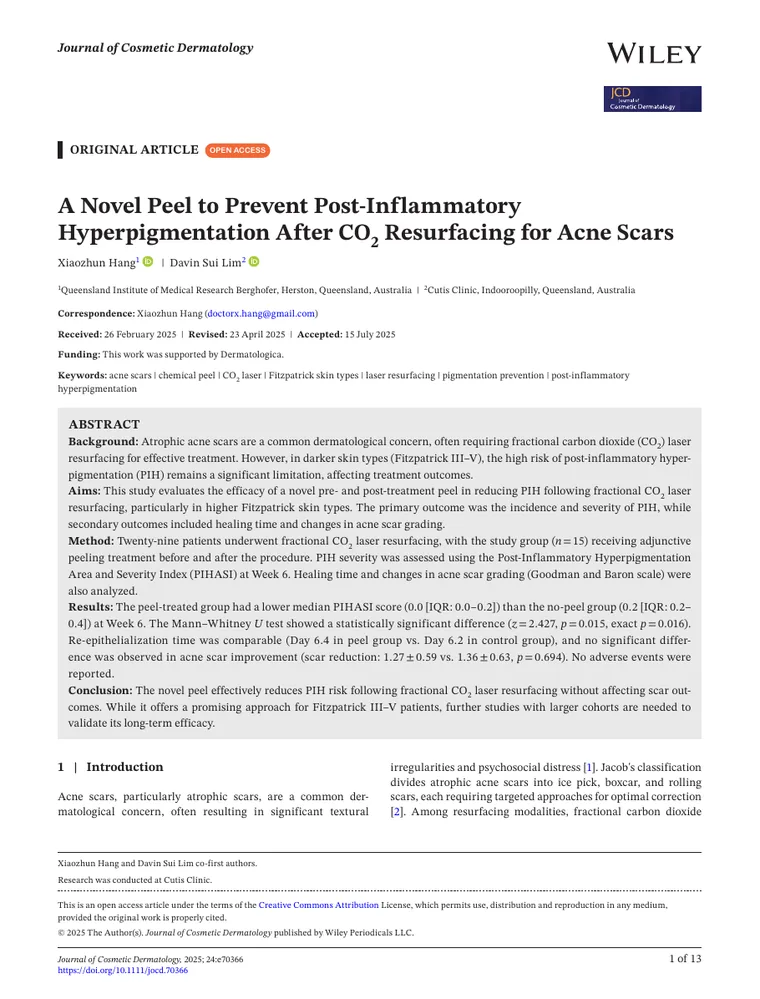
A Novel Peel to Prevent Post-Inflammatory Hyperpigmentation After CO₂ Resurfacing for Acne Scars
Dark marks after CO₂ laser are the reason many people with darker skin are never offered the treatment at all. A peel given before and after the laser reduced them — without slowing healing or costing any of the scar improvement.
Four numbers worth knowing
What we found
The peel group had measurably less pigment.
At six weeks, the median pigmentation score was 0.0 in the peel group against 0.2 in the group that had no peel. The difference was statistically significant.
It did not slow healing.
Skin re-surfaced at 6.4 days in the peel group and 6.2 days in the control group. For practical purposes, identical.
It cost nothing in scar improvement.
Scar grading improved by 1.27 points with the peel and 1.36 without it — a difference well inside the noise. The peel prevents a complication without blunting the treatment.
No adverse events occurred in either group.
Across 29 patients, none.
This matters most for the patients most often turned away.
CO₂ laser remains the most effective treatment for atrophic acne scars, and pigment risk is the single reason it is withheld from darker skin. Reduce that risk and the treatment becomes available to the people who need it most.
What this means for you
Pigment risk is not a reason to accept a weaker treatment
Non-ablative and radiofrequency options carry less pigment risk, but they do not match CO₂ laser for dermal remodelling. Managing the risk is a better answer than downgrading the treatment.
Prevention beats treatment here
Once established, this pigment can persist for years and needs prolonged treatment of its own. Everything in this trial is about stopping it forming in the first place.
Ask what the pigment plan is, not just the laser plan
If you have skin type III or above and you are being offered ablative resurfacing, the pigment strategy should be part of the conversation before the laser is switched on.
Why this matters
Fractional CO₂ laser is the standard against which other treatments for atrophic acne scars are measured. It works on all three scar types at once, and the depth of remodelling is not matched by gentler alternatives.
Its limitation is pigment. In Fitzpatrick type IV and above, up to 92% develop post-inflammatory hyperpigmentation after ablative CO₂ treatment. Once it appears it can last years. That single fact is what makes the most effective scar treatment unavailable to a large part of the population — which is why the prevention question is worth a trial.
Who was studied
A prospective, single-centre, randomised, evaluator-blinded trial. Thirty patients aged 17 to 45, Fitzpatrick skin types III to V, all with grade 4B acne scars, randomised to receive a peel system before and after their fractional CO₂ resurfacing or no peel at all. One patient in the control group dropped out.
- Randomised
- 30 patients
- Analysed
- 29 (15 peel / 14 control)
- Skin types
- Fitzpatrick III–V
- Age range
- 17–45
- Endpoint
- 6 weeks
Who paid for this
This trial was funded by the manufacturer of the peel system tested. The authors declared it in the paper, and it is stated here for the same reason: a positive result from a manufacturer-funded study of a single product carries less weight than the same result from an independent one, and you should weigh it accordingly.
What this study cannot tell you
Every study has a boundary, and it is fairer to state it than to leave you to guess.
- Twenty-nine patients at a single centre. Small, and the trial is explicit about that.
- The endpoint was six weeks. Whether the benefit holds beyond that is unknown.
- Only Fitzpatrick types III to V were studied. Type VI was not included.
- One specific commercial peel system was tested. Nothing here shows that peels in general have this effect.
- Funded by the manufacturer of the product tested.
Questions people actually ask
Will CO₂ laser give me dark marks?
If your skin type is Fitzpatrick IV or above, the reported rate after ablative CO₂ treatment is up to 92% — so the honest answer is that it is likely rather than possible.
That is not an argument against the laser. It is an argument for planning the pigment side of the treatment before it starts, which is exactly what this trial was testing.
Can dark skin have CO₂ laser resurfacing?
Yes, and the results for acne scarring are the best available. The pigment risk is real and higher than in pale skin, which is why it needs to be actively managed rather than hoped away.
The alternative that is often offered instead — a gentler, non-ablative device — carries less pigment risk but does not deliver the same dermal remodelling.
Does a peel before laser affect the scar result?
In this trial, no. Scar improvement was 1.27 points with the peel and 1.36 without — a difference small enough to be noise, in a study this size.
Healing time was also unchanged, at 6.4 days versus 6.2.
Cite this paper
Hang X, Lim DS. A Novel Peel to Prevent Post-Inflammatory Hyperpigmentation After CO₂ Resurfacing for Acne Scars. Journal of Cosmetic Dermatology. 2025. doi:10.1111/jocd.70366
Related reading
Want this assessed properly?
A virtual consultation gives you a written report and a plan before we speak.
Published 2025 · Summary written and reviewed by Dr Davin Lim, FACD · General information, not personal medical advice.
Have some questions?
Send a message and it will be answered personally. Form endpoint — to be wired in production