Sunscreen, acne and dark marks in darker skin
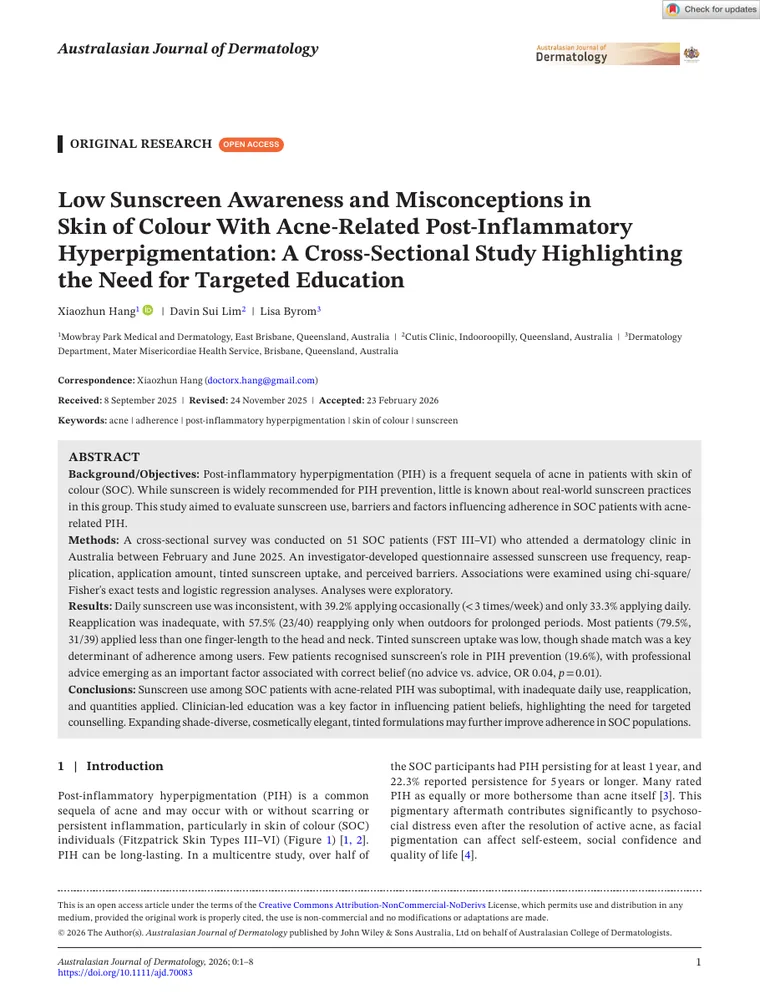
Low Sunscreen Awareness and Misconceptions in Skin of Colour With Acne-Related Post-Inflammatory Hyperpigmentation: A Cross-Sectional Study Highlighting the Need for Targeted Education
Most people with darker skin who get dark marks after acne are using sunscreen too rarely and in too small an amount — and almost none of them know that sunscreen is the thing that stops those marks getting worse.
Five numbers worth knowing
What we found
Sunscreen use was inconsistent.
Only one in three people used sunscreen daily. One in five never used it at all, and another 39% used it fewer than three times a week.
Almost nobody used enough.
Four out of five sunscreen users applied less than one finger-length to the whole face and neck. The guideline is two. Across the entire study, two people met it.
Nobody reapplied often enough.
A third of users never reapplied at all, and most of the rest only topped up when outdoors for long stretches. Not one person reapplied every two to three hours, as the Australasian College of Dermatologists advises.
The link between sunscreen and dark marks was almost unknown.
90% knew sunscreen prevents sunburn and 71% knew it lowers skin cancer risk — but only 19.6% knew it helps prevent the pigment acne leaves behind. More than half were simply uncertain.
Being told by a professional changed everything.
People who had never received professional advice about sunscreen had 96% lower odds of understanding its role in preventing dark marks. Of everything measured, this was the strongest predictor — stronger than age, sex or skin type.
Tinted sunscreen was chosen for its colour, not its protection.
Only a quarter used a tinted sunscreen. Of those who did, 92% chose it because the shade matched — and not one chose it for visible-light protection, which is the reason it works better for this particular problem.
What this means for you
Two fingers, not one
Squeeze a line of sunscreen along your index finger and your middle finger. Together, that is the amount for your face and neck. Four out of five people in this study used less than half of it.
Every two to three hours outdoors
Once in the morning is not reapplication. If you are out for the day, it needs topping up — and no one in this study was doing that.
Tinted is not cosmetic — it is the point
Tinted sunscreens containing iron oxides block visible light as well as UV. Visible light drives pigmentation in deeper skin, and tinted formulations reduce it by 93–98%. Plain sunscreen does not filter it at all.
Melanin is not sunscreen
Deeper skin does burn less, and that part of the belief is true. But after acne inflammation the pigment cells in darker skin are larger, more numerous and more reactive — which is exactly why the marks last longer.
Indoors is lower risk, not no risk
Window glass passes UVA and visible light. Long stretches beside a bright window still count. Thirty per cent of people who never reapplied said sunscreen was unnecessary indoors.
Find one you will actually wear
Greasiness and heaviness were the second most common reason people stopped reapplying. The sunscreen that works is the one that does not feel like a chore.
Why this matters
Post-inflammatory hyperpigmentation — the brown or grey marks left where a spot used to be — is one of the most common consequences of acne in skin of colour. In one multicentre study, over half of patients with darker skin still had those marks a year later, and 22% had them for five years or more.
Many people find the marks more bothersome than the acne itself. They are also harder to treat than the spots that caused them, and several of the treatments that work — peels, lasers, depigmenting creams — can make things worse in darker skin if they are used badly.
Sunlight makes it worse in two ways. Ultraviolet light stimulates pigment production directly. And high-energy visible light — the blue part of ordinary daylight, around 415 nm — activates a receptor called OPN3 in pigment cells, a pathway that matters far more in Fitzpatrick types IV to VI than in pale skin. That is the piece a standard SPF number does not cover, and the reason tinted formulations are not a cosmetic afterthought here.
The practical upshot
Photoprotection is not a nice-to-have alongside treatment for these marks. It is part of the treatment, it is the cheapest part, and it is the part patients are most often never told about.
Who was studied
A cross-sectional survey at a single dermatology centre in Brisbane, between February and June 2025. Everyone had pigmentation following acne, with or without scarring; people whose pigmentation came from something else — melasma, or pigment after a procedure — were excluded.
- Participants
- 51 adults
- Mean age
- 28.6 years
- Female
- 58.8%
- Skin types
- Fitzpatrick III–VI
- Most common
- Type IV (43.1%)
What this study cannot tell you
Every study has a boundary, and it is fairer to state it than to leave you to guess.
- Fifty-one people at one clinic in Brisbane. That is a real finding about a real group, not a population estimate.
- Everything was self-reported. What people say they do and what they actually do are rarely identical, and both are usually generous.
- The questionnaire was written for this study and has not been formally validated.
- Only thirteen people used tinted sunscreen — too few to draw firm conclusions about that group specifically.
- The statistical findings are exploratory. They point at a relationship between professional advice and understanding; they do not prove one caused the other.
Questions people actually ask
Does sunscreen stop acne marks from going dark?
It helps stop them getting darker and lasting longer. Sunlight — both ultraviolet and visible light — stimulates pigment cells that are already over-active after acne inflammation.
Sunscreen will not remove a mark you already have. What it does is stop that mark deepening while it fades, which is why it belongs alongside whatever treatment you are using rather than instead of it. In this study, only one person in five knew this.
How much sunscreen should I actually use on my face?
Two finger-lengths for the face and neck together — a line of sunscreen along your index finger and another along your middle finger.
In this study, four out of five people applied less than one finger-length. An SPF 50 applied at half the amount does not give you SPF 50.
Do I need sunscreen if I have dark skin?
For acne marks, yes. Deeper skin burns less and carries a lower skin cancer risk — that part of the belief is correct, and Australian guidance reflects it.
But melanin does not protect against the pigment response itself. After acne inflammation, pigment cells in deeper skin are larger and more reactive, which is precisely why the marks last longer. Nearly half the people in this study who never reapplied said they did not think their skin type needed it.
What is tinted sunscreen, and do I need it?
Tinted sunscreens contain iron oxides, which block visible light as well as ultraviolet. Ordinary sunscreens do not filter visible light, and visible light is a major driver of pigmentation in darker skin.
For acne-related dark marks in skin of colour, a tinted formulation matched to your shade is the better choice. Shade match is also what makes people keep using it — it was the deciding factor for 92% of the tinted users in this study.
Cite this paper
Hang X, Lim DS, Byrom L. Low Sunscreen Awareness and Misconceptions in Skin of Colour With Acne-Related Post-Inflammatory Hyperpigmentation: A Cross-Sectional Study Highlighting the Need for Targeted Education. Australasian Journal of Dermatology. 2026. doi:10.1111/ajd.70083
Related reading
Want this assessed properly?
A virtual consultation gives you a written report and a plan before we speak.
Published 2026 · Summary written and reviewed by Dr Davin Lim, FACD · General information, not personal medical advice.
Have some questions?
Send a message and it will be answered personally. Form endpoint — to be wired in production