How melasma is actually treated, in order
Clinical Pearls: Melasma Management
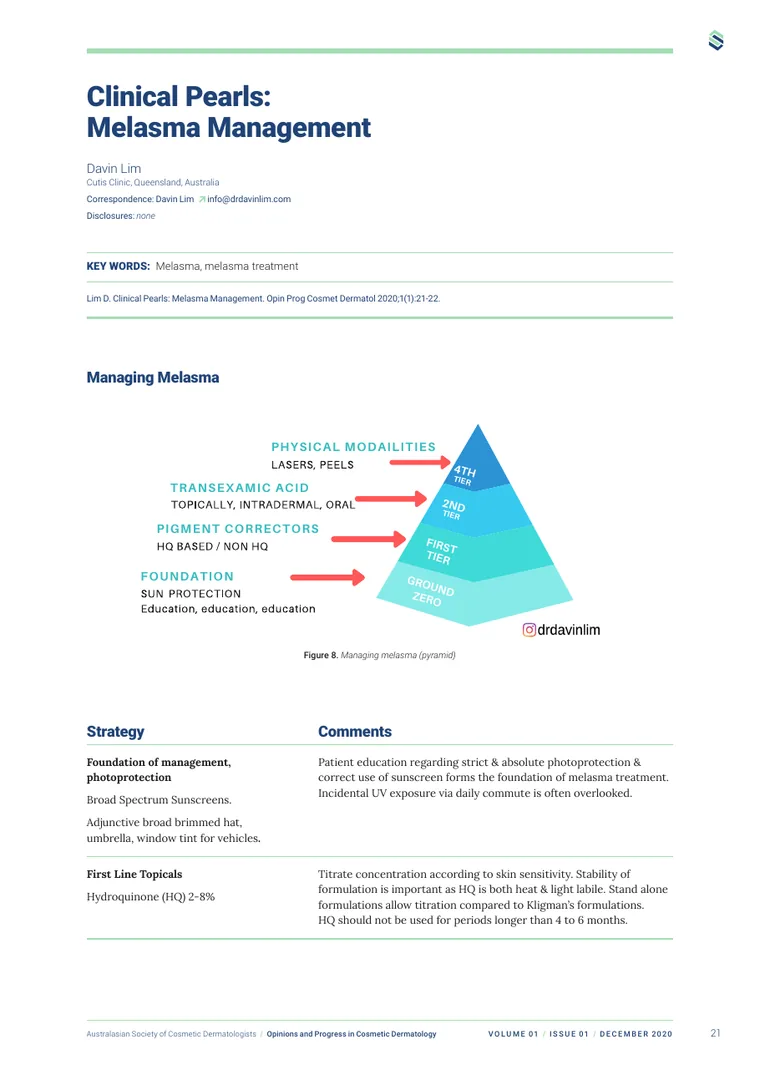
Melasma treatment is a pyramid, and almost everyone tries to start near the top. Sun protection is the ground floor, pigment correctors come first, tranexamic acid second, and lasers and peels are the fourth tier — not the first.
Four numbers worth knowing
What we found
Sun protection is the ground floor, and it is where most plans fail.
Strict photoprotection and correct sunscreen use are the foundation of melasma treatment. Incidental exposure on the daily commute is the part that is most often overlooked — along with hats, umbrellas and window tinting, which are named alongside sunscreen rather than as afterthoughts.
Pigment correctors are first-line, and hydroquinone is titrated.
Concentration is matched to skin sensitivity, from 2% to 8%. Formulation stability matters because hydroquinone degrades with heat and light. Stand-alone preparations allow titration in a way fixed combination formulas do not, and it should not be used continuously beyond four to six months.
Second-line topicals are for rotation, not replacement.
Tretinoin, ascorbic acid, azelaic acid, arbutin, botanicals, AHAs, kojic acid and cysteamine. Kojic acid is kept to 1–2% to reduce contact dermatitis. The purpose is rotational therapy — giving the skin a break from one agent without stopping treatment.
Tranexamic acid is the second tier.
Oral doses of 250 to 500 mg should be considered as an adjunct where there is no contraindication. Its efficacy is well documented, and it remains off-label for melasma and post-inflammatory pigmentation.
Lasers are fourth-tier, and the settings matter more than the machine.
Low-fluence 1064 nm Nd:YAG toning gives good results at low risk, but sessions must be at least two weeks apart to reduce permanent spotty hypopigmentation. Picosecond lasers can be effective, though post-inflammatory pigmentation and melasma flares are more common with them than with nanosecond devices. Fractional 1927 thulium and diode lasers are promising, and pulse dye, KTP and copper bromide address the vascular component.
Peels have a narrow role, and microneedling has less.
Superficial peels — retinoic acid, AHA, low-concentration TCA at 10–15% — are useful adjuncts in epidermal melasma. Microneedling, with or without PRP, is described plainly as having limited value.
What this means for you
If you are being offered laser first, ask why
On this framework lasers are the fourth tier. They sit above sun protection, pigment correctors and tranexamic acid — not instead of them.
Education is listed as part of the foundation
The pyramid's base reads “sun protection — education, education, education”. That is not padding. Melasma is managed rather than cured, and the daily habits do more of the work than anything applied in a clinic.
Hydroquinone has a clock on it
Four to six months of continuous use, then a switch to non-hydroquinone maintenance. Indefinite use is how ochronosis happens.
The commute is the exposure you forget
Named specifically in this article. Car windows, walking between buildings, sitting by a window — the incidental exposure adds up and is invisible precisely because it is routine.
Two weeks between laser sessions, minimum
Spacing sessions is what reduces the risk of permanent spotty hypopigmentation from toning. Faster is not better here.
Why this matters
Melasma is chronic and relapsing, and the treatments that work do so gradually. That combination makes it tempting to reach for the most dramatic intervention available — which in pigmentation is usually the one most likely to backfire.
This piece sets the order out as a pyramid. It is a clinician's summary, but the sequence is the most useful thing a patient can understand about their own treatment, because it explains why a good plan can look unglamorous for the first several months.
The shape of it
Ground zero: sun protection and education. First tier: pigment correctors. Second tier: tranexamic acid. Fourth tier: lasers and peels. Anyone starting at the top is building on nothing.
What this study cannot tell you
Every study has a boundary, and it is fairer to state it than to leave you to guess.
- A clinical pearls summary, not a systematic review. It reflects one dermatologist's practice framework, informed by the literature but not a formal appraisal of it.
- No effect sizes, response rates or comparative data are offered.
- Written in 2020. Tranexamic acid evidence and picosecond laser experience have both moved since — and on picosecond lasers specifically, this article's caution has since been borne out.
- Oral tranexamic acid for melasma is off-label, as the article states, and carries contraindications that need individual assessment.
Questions people actually ask
What is the best treatment for melasma?
There isn't a single one, and that is the honest answer. Melasma is managed in layers: strict sun protection as the foundation, then pigment-correcting creams, then oral tranexamic acid where appropriate, and lasers or peels last.
The order matters more than any individual item on the list. Treatments applied out of sequence tend to disappoint, and some of them make the pigment worse.
How long can you use hydroquinone?
Four to six months of continuous use is the limit given here, after which the recommendation is to switch to non-hydroquinone maintenance.
Concentration is titrated between 2% and 8% depending on how sensitive your skin is. Prolonged uninterrupted use is what leads to ochronosis — a blue-black discolouration that is considerably harder to treat than the melasma was.
Does laser work for melasma?
It can, in the right place in the sequence and at the right settings. Low-fluence 1064 nm toning gives good results at low risk, provided sessions are at least two weeks apart.
What the article is careful about is picosecond lasers: effective, but with more post-inflammatory pigmentation and more melasma flares than nanosecond devices. That caution has aged well.
Does microneedling help melasma?
On this assessment, it has limited value — with or without PRP. It is reported in the literature for many skin conditions, but melasma is not where it earns its place.
Cite this paper
Lim D. Clinical Pearls: Melasma Management. Opinions and Progress in Cosmetic Dermatology. 2020;1(1):21–22.
Related reading
Want this assessed properly?
A virtual consultation gives you a written report and a plan before we speak.
Published 2020 · Summary written and reviewed by Dr Davin Lim, FACD · General information, not personal medical advice.
Have some questions?
Send a message and it will be answered personally. Form endpoint — to be wired in production