Does HRT cause melasma?
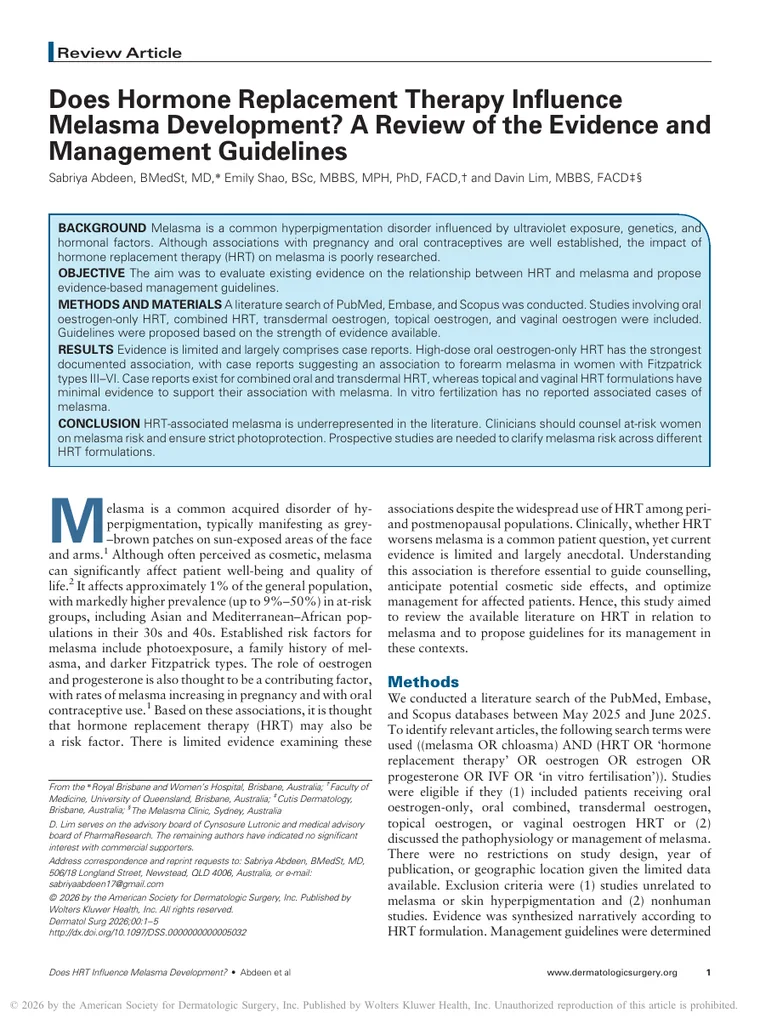
Does Hormone Replacement Therapy Influence Melasma Development? A Review of the Evidence and Management Guidelines
The honest answer is that the risk looks low for every form of HRT, but the evidence is so thin that nobody can say so with confidence — and that is worth knowing before you either worry about it or dismiss it.
Four numbers worth knowing
What we found
Oral oestrogen-only HRT has the strongest association — which is still weak.
The evidence is limited to case reports and one small randomised trial, and points mainly at high-dose preparations. The characteristic pattern reported is melasma on the forearms in women with Fitzpatrick types III to VI.
Combined oral HRT: case reports only.
Both hormones are implicated in how melasma develops, and isolated cases exist. Sun exposure appears to act as a cofactor in most of them. The evidence is moderate to weak and the risk is judged low.
Transdermal oestrogen: weaker still, and confounded.
The few case reports that exist frequently involve women also taking oral HRT, which makes it impossible to attribute the melasma to the patch. Patches bypass first-pass liver metabolism and give lower systemic exposure, but no study has examined whether that translates into lower melasma risk.
Topical oestrogen: a single case report in the entire literature.
One woman with type II skin who developed facial melasma six months after starting an oestrogen cream for photoageing. That is the whole evidence base.
Vaginal oestrogen: no documented cases at all.
Low-dose vaginal preparations produce plasma oestradiol levels below the premenopausal range, and no melasma has been linked to them. No routine dermatological precaution is warranted.
IVF: no reported cases, despite the hormonal load.
IVF regimens drive oestrogen and progesterone high, and hormone receptors show strong positivity in melasma lesions of IVF patients — but no case series links the two, so no recommendation could be made.
What this means for you
This is not a reason to avoid HRT
Across every formulation reviewed, the risk was judged low. Melasma is a cosmetic condition; the reasons women take HRT are not. The two should not be weighed as though they were equivalent.
If you already have melasma, say so
A history of melasma in pregnancy or on the contraceptive pill is the most useful thing you can tell the doctor prescribing your HRT. It is exactly the group the counselling recommendations are aimed at.
Sun exposure is the cofactor in almost every case
In most of the reported cases, significant UV exposure preceded the melasma. Photoprotection is the one modifiable factor that runs through the whole literature.
Lower systemic exposure is the sensible preference
Where there is a choice and melasma is a genuine concern, transdermal, topical and vaginal preparations carry lower systemic exposure than oral ones — on mechanism, not on outcome data, which does not exist.
Why this matters
Melasma is strongly influenced by female sex hormones. Oestrogen activates receptors on pigment cells, increasing tyrosinase activity and melanin synthesis; rates rise in pregnancy and with the oral contraceptive pill. Around a third of patients have a family history, and prevalence reaches 9–50% in at-risk populations against about 1% in the general population.
Given all of that, whether HRT worsens melasma is an obvious question, and women ask it constantly. It turns out to be one of the least studied questions in the field — which is itself the finding.
Who was studied
A literature search of PubMed, Embase and Scopus between May and June 2025, covering oral oestrogen-only, combined oral, transdermal, topical and vaginal HRT. No restriction was placed on study design, year or location, because the available data is so limited.
- Records screened
- 203
- Studies included
- 23
- Case studies
- 5
- Randomised trials
- 1
What this study cannot tell you
Every study has a boundary, and it is fairer to state it than to leave you to guess.
- Twenty-three papers, of which most were reviews or expert opinion rather than original data.
- Not one cohort, case–control or large-scale observational study exists on this question.
- Case reports cannot establish cause. They establish that something happened once, in one person.
- Several transdermal cases were confounded by concurrent oral HRT use, so the formulation cannot be blamed.
- Recommendations on IVF were left out of the guidelines entirely, because the evidence was too limited to support any.
Questions people actually ask
Can HRT cause melasma?
It can, but on the evidence available it is uncommon. Every association reported rests on case reports rather than on studies designed to measure risk.
Oral oestrogen-only preparations at higher doses carry the strongest signal, and even that is graded moderate to weak.
Which type of HRT is least likely to cause melasma?
Vaginal oestrogen has no documented association at all, and low-dose preparations produce plasma oestradiol below premenopausal levels.
Topical oestrogen has a single case report in the entire literature. Transdermal patches give lower systemic exposure than oral formulations, though no study has tested whether that means less melasma.
Should I stop HRT if I develop melasma?
That is a decision for you and the doctor who prescribed it, weighing what the HRT is doing for you against a cosmetic condition that can be treated on its own terms.
One case report describes lesions partially fading over six months after stopping. But melasma is manageable with photoprotection, topical treatment and, where appropriate, laser — so stopping is rarely the only option on the table.
Does IVF cause melasma?
No case reports currently link them, despite IVF regimens producing very high oestrogen and progesterone levels.
Hormone receptors do show strong positivity in melasma lesions of IVF patients, but that is a mechanism, not a correlation. The review deliberately made no recommendation on IVF because the evidence was too thin to support one.
Cite this paper
Abdeen S, Shao E, Lim D. Does Hormone Replacement Therapy Influence Melasma Development? A Review of the Evidence and Management Guidelines. Dermatologic Surgery. 2026. doi:10.1097/DSS.0000000000005032
Related reading
Want this assessed properly?
A virtual consultation gives you a written report and a plan before we speak.
Published 2026 · Summary written and reviewed by Dr Davin Lim, FACD · General information, not personal medical advice.
Have some questions?
Send a message and it will be answered personally. Form endpoint — to be wired in production