What sun protection actually costs in darker skin
Australian Sunscreens: The Price of Protection for Skin of Colour With Pigmentary Disorders
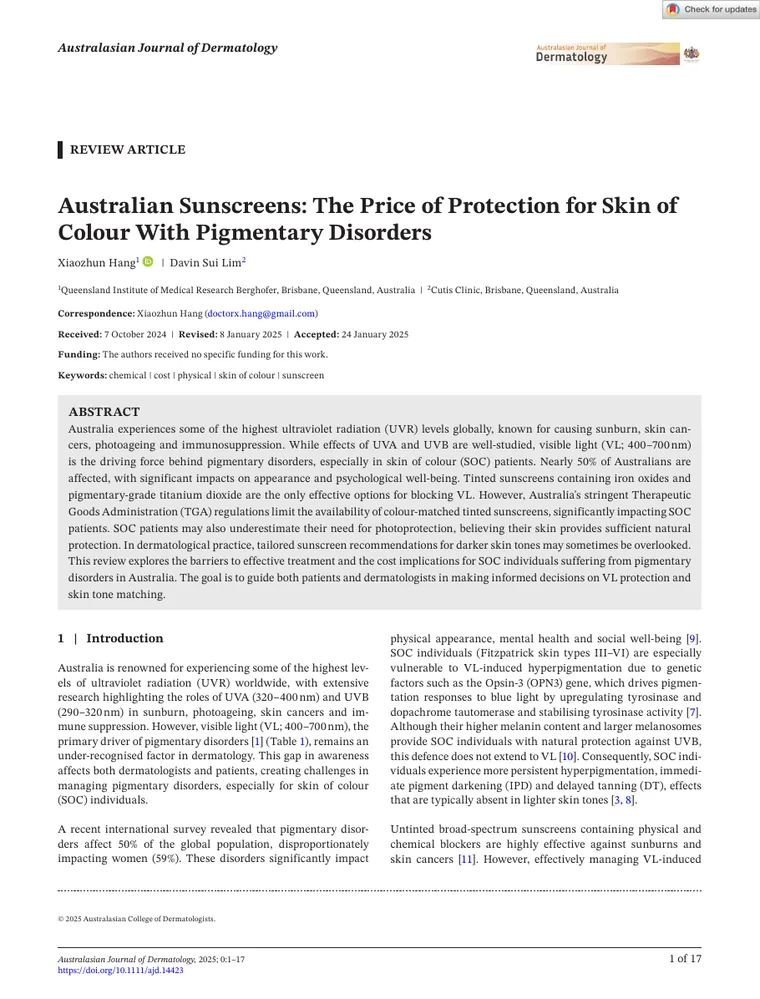
The sunscreen that actually protects darker skin from pigmentation is tinted, and following the official reapplication advice with it costs between $3,040 and $18,250 a year. That is the real barrier, and almost nobody names it.
Five numbers worth knowing
What we found
Visible light is the problem, and SPF does not measure it.
SPF rates protection against UVB. Visible light — roughly half of the sunlight reaching your skin — is what drives pigmentation in Fitzpatrick types III to VI, through a blue-light receptor called OPN3. An SPF 50 number tells you nothing about it.
Only tinted sunscreens block it.
Iron oxides combined with pigment-grade, non-micronised titanium dioxide reduce visible light transmission by 93–98%. Nanosized mineral filters and chemical filters do not. This is the entire reason tinted formulations matter here, and it is a functional reason, not a cosmetic one.
The cost is the barrier nobody quotes.
Applying tinted sunscreen to the face and neck twice a day costs between $730 and $8,285 a year depending on the product. Follow the College's two-hourly reapplication advice properly and the range becomes $3,040 to $18,250.
Australian regulation limits the shade range.
Iron oxides are classified as inactive ingredients rather than UV filters, and the TGA's rules on therapeutic goods restrict which colour-matched tinted sunscreens reach the Australian market. Patients who cannot find their shade buy overseas products that carry no Australian approval at all.
Poor shade match is a compliance problem, not a vanity one.
A sunscreen that leaves a grey or chalky cast on deeper skin does not get worn. Colour matching is named in this review as one of the key barriers to patients actually using the product that would help them.
The advice itself is inconsistent.
A national survey found 85% of Australian dermatologists lacked confidence managing cosmetic concerns in skin of colour, and over 80% wanted more training in it. Sunscreen advice is usually built around SPF and broad-spectrum labelling, which addresses sunburn and skin cancer rather than pigment.
What this means for you
Look for iron oxides on the label
Not SPF, not “broad spectrum” — iron oxides. They are what blocks visible light, and they are why the product is tinted in the first place. Pigment-grade titanium dioxide and zinc oxide help too; the nanosized versions do not.
Cost per millilitre, not cost per tube
The products in this review ranged from $0.20 to $2.27 per millilitre. At 5 mL for face and neck per application, that difference decides whether the annual cost is $730 or $8,285. The cheapest effective option is not the cheapest tube.
Makeup with iron oxides counts
The review names one practical strategy directly: combining an iron oxide-rich foundation over a physical sunscreen gives visible-light protection without the white cast, and often costs less than a dedicated tinted sunscreen.
If the shade is wrong you will stop using it
This is the honest reason to spend time on colour matching rather than buying whatever is on the shelf. A product you wear at 60% of the recommended amount beats a better one sitting in a drawer.
Shade, hats and clothing are free
Sun avoidance, shade-seeking and photoprotective clothing are listed in this review as essential rather than optional — partly because they work, and partly because they cost nothing per application.
Why this matters
Australia has among the highest ultraviolet levels in the world, and its public health messaging is built around that: SPF 50+, broad spectrum, sunburn and skin cancer. For most Australians that is the right message.
It is not the whole message for the 48% of the population with a pigmentary disorder. Melasma, the marks acne leaves behind, ashy dermatosis and sun spots are driven substantially by visible light, which SPF does not measure and most sunscreens do not filter. Twenty-eight per cent of Australians surveyed reported a quality-of-life impact above 10 out of 30 from these conditions, and 44% reported feeling stigmatised by them.
So the product that would help is a specific one, it is harder to find in the right shade in Australia than elsewhere, and it is expensive. This review put a number on that last part.
Why the cost figure matters
Telling a patient to reapply tinted sunscreen every two hours without knowing it may cost them several thousand dollars a year is advice that will simply be ignored. Naming the number is what makes the conversation about what is achievable rather than what is ideal.
Who was studied
A review of the sunscreen products available in Australia, their visible-light-blocking ingredients, their shade ranges and their cost per millilitre — set against the Australasian College of Dermatologists' application and reapplication guidance, and the TGA framework that governs what reaches the market.
- Products costed
- 20+ tinted sunscreens
- Cost basis
- ACD 2 mg/cm² guidance
- Face and neck
- 5 mL per application
- Filters approved in Australia
- 27 organic, 2 inorganic
What this study cannot tell you
Every study has a boundary, and it is fairer to state it than to leave you to guess.
- This is a review, not an original study. Nothing here was measured experimentally.
- The cost figures do not account for differences between formulations — milks, creams and lotions may need different volumes to reach the same protection.
- No statistical comparison was made between single-shade and multi-shade products, so differences in price and availability between those categories remain unquantified.
- It does not cover every tinted sunscreen on the Australian market, and it draws on neither social media, consumer forums nor print media for the patient-side view.
- Prices move. The figures are a snapshot of the Australian market at the time of writing.
Questions people actually ask
How much sunscreen do I actually need per day?
The Australasian College of Dermatologists recommends 2 mg per square centimetre — about 35 mL for the whole body, or 5 mL for the face and neck. The teaspoon rule is the practical version: one teaspoon for face, head and neck, one for each arm, two for the torso, two for each leg.
Most people apply a quarter to a half of that. At 0.5 mg/cm², the effective SPF drops by roughly 75% — so an SPF 50 applied thinly is not an SPF 50.
Why is tinted sunscreen better for pigmentation?
Because of the iron oxides in it. They block visible light, which ordinary sunscreens do not filter at all, and visible light is a major driver of pigmentation in deeper skin.
Tinted formulations reduce visible light transmission by 93–98%. That is a functional difference, not a cosmetic one, and it is why the tint is the point rather than a side effect.
Why is tinted sunscreen so expensive in Australia?
Partly the products themselves, and partly regulation. Iron oxides are treated as inactive ingredients rather than UV filters, and the TGA's framework for therapeutic goods limits which colour-matched tinted formulations reach the Australian market.
The result is a narrow shelf, narrow shade ranges, and prices from $0.20 to $2.27 per millilitre. Following the reapplication guidance properly lands somewhere between $3,040 and $18,250 a year.
Does darker skin need sunscreen?
For sunburn and skin cancer, the risk is genuinely lower, and Australian guidance reflects that. For pigmentation, the answer is different.
Higher melanin content gives some natural protection against UVB, but that defence does not extend to visible light. People with deeper skin experience more persistent hyperpigmentation, immediate pigment darkening and delayed tanning — effects that are largely absent in lighter skin.
Cite this paper
Hang X, Lim DS. Australian Sunscreens: The Price of Protection for Skin of Colour With Pigmentary Disorders. Australasian Journal of Dermatology. 2025. doi:10.1111/ajd.14423
Related reading
Want this assessed properly?
A virtual consultation gives you a written report and a plan before we speak.
Published 2025 · Summary written and reviewed by Dr Davin Lim, FACD · General information, not personal medical advice.
Have some questions?
Send a message and it will be answered personally. Form endpoint — to be wired in production