What can go wrong with subcision
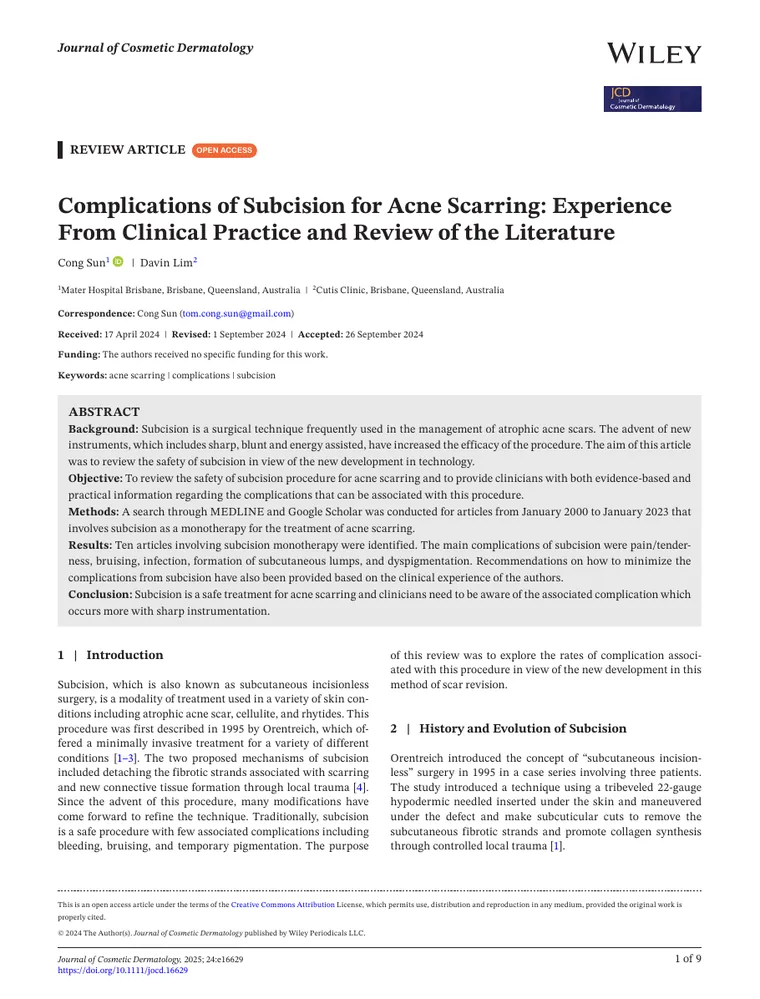
Complications of Subcision for Acne Scarring: Experience From Clinical Practice and Review of the Literature
Subcision is a safe procedure for acne scarring, but it is not a procedure without consequences — and the instrument chosen changes which consequences you get.
Four numbers worth knowing
What we found
The common complications are predictable, and most settle by themselves.
Pain and tenderness, bruising, swelling, lumps under the skin and pigment changes account for almost all of them. The majority resolve without any further treatment.
Sharp instruments cause more trouble than blunt ones.
In a split-face study directly comparing a Nokor needle with a blunt blade on the same person, the needle side had more bruising, more haematomas, more lumps and more pigmentation. The difference in bruising was statistically significant.
Infection is uncommon, and instrument choice matters.
In a randomised trial of 100 patients, four infections occurred in the needle group and none in the cannula group. Infection after subcision remains rare either way.
Numbness is common and usually temporary.
The sensory nerves of the face sit at the same depth as the dissection, so some numbness is expected — particularly on the forehead, where the nerves run superficially. It usually recovers within six to eighteen months. Permanent numbness has been described but is uncommon, and true nerve pain is exceedingly rare.
Pigment marks come mostly from the entry point, not the dissection.
Post-inflammatory hyperpigmentation after subcision is driven largely by the instrument's entry line and by bleeding under the skin. Fewer entry points, longer instruments, careful control of bleeding and strict sun protection afterwards all reduce it.
The published evidence is thinner than it looks.
Ten studies, mostly small case series, with complication reporting that is inconsistent and often descriptive rather than counted. Quantitative rates are frequently missing altogether.
What this means for you
Ask which instrument is being used
Blunt cannulas and blades carry a lower risk of bruising, haematoma, lumps and pigmentation than sharp needles. That is one of the few things in this literature with direct comparative evidence behind it.
Expect bruising, and plan around it
Bruising is the most consistently reported effect. It is not a complication so much as a certainty — the question is how much, and for how long.
Tell your doctor about blood thinners
Anything that increases bleeding time increases the risk of a haematoma. That includes medications and supplements you might not think to mention.
Sun protection afterwards is not optional
The pigment marks that follow subcision are preventable ones. Strict photoprotection in the weeks afterwards is the cheapest part of the whole treatment.
Why this matters
Subcision releases the fibrous tethers that pull a rolling acne scar down from beneath. It was first described in 1995, and the instruments have multiplied since — hypodermic and Nokor needles, blunt and sharp cannulas, cataract blades, and broad-headed dissectors.
Each of those instruments has a different risk profile, and the choice is usually made by the operator rather than discussed with the patient. This review pulled together what the published evidence actually shows about that choice, alongside what we see in clinical practice.
Who was studied
A search of MEDLINE and Google Scholar for studies published between January 2000 and January 2023, limited to subcision used on its own rather than combined with other treatments — so that the complications reported could be attributed to subcision itself.
- Studies included
- 10
- Split-face studies
- 5
- Randomised trials
- 2
- Period searched
- 2000–2023
What this study cannot tell you
Every study has a boundary, and it is fairer to state it than to leave you to guess.
- Ten studies, most of them small case series. This is a review of a thin literature, not a large trial.
- Complication reporting across these studies is inconsistent, and often descriptive rather than counted — which makes true rates impossible to calculate.
- Where quantitative data existed, the studies rarely broke it down by specific complication.
- Part of the guidance here comes from the authors' own clinical experience rather than from the published studies, and is labelled as such in the paper.
Questions people actually ask
Is subcision safe?
Yes, on the evidence available. The complications that occur are mostly mild, mostly temporary and mostly settle without further treatment.
The important caveat is that the published literature is small and its reporting is inconsistent, so "safe" here means "no signal of serious harm across ten studies", not "proven safe in thousands of patients".
How long does bruising last after subcision?
Bruising is the most commonly reported effect and it is essentially expected rather than exceptional. Most of it settles over one to two weeks.
Blunt instruments produce significantly less of it than sharp needles — that difference held up statistically in a split-face comparison where the same patient had each technique on one side.
Will subcision leave me with numbness?
Some altered sensation is common, because the sensory nerves of the face lie at the same depth as the dissection. The forehead is most often affected, since the nerves there run closest to the surface.
In most cases it recovers on its own within six to eighteen months. Permanent numbness has been described, but it is uncommon.
Can subcision cause lumps?
Yes. Lumps under the skin after subcision are usually either a haematoma — a collection of blood — or reactive fibroplasia, which is new connective tissue forming in response to the injury.
They are more common with sharp instruments. Small ones often settle with firm daily massage over several weeks; larger or more persistent ones may need to be drained or treated with a dilute injection.
Cite this paper
Sun C, Lim D. Complications of Subcision for Acne Scarring: Experience From Clinical Practice and Review of the Literature. Journal of Cosmetic Dermatology. 2025. doi:10.1111/jocd.16629
Related reading
Want this assessed properly?
A virtual consultation gives you a written report and a plan before we speak.
Published 2025 · Summary written and reviewed by Dr Davin Lim, FACD · General information, not personal medical advice.
Have some questions?
Send a message and it will be answered personally. Form endpoint — to be wired in production