A finer tool for ice pick scars
Repurposing follicular unit extraction punches for excision of ice pick acne scars
Ice pick scars are narrow and deep, which is exactly what lasers and peels handle worst. Borrowing a punch from hair transplant surgery lets the tool be matched to each scar rather than the scar to the tool.
Four numbers worth knowing
What we found
Ice pick scars are the ones that resist everything else.
They are narrow, deep and steep-walled. Chemical reconstruction methods such as TCA or phenol improve them but need repeated sessions and often clear them incompletely. Fractional ablative lasers help texture generally but are adjunctive for these specific scars.
Standard punch biopsy tools are a poor match.
They come in limited diameters, which makes precise matching to a scar difficult, and they blunt after several excisions — so efficiency falls away exactly when you are treating a face full of scars.
Follicular unit extraction punches solve both problems.
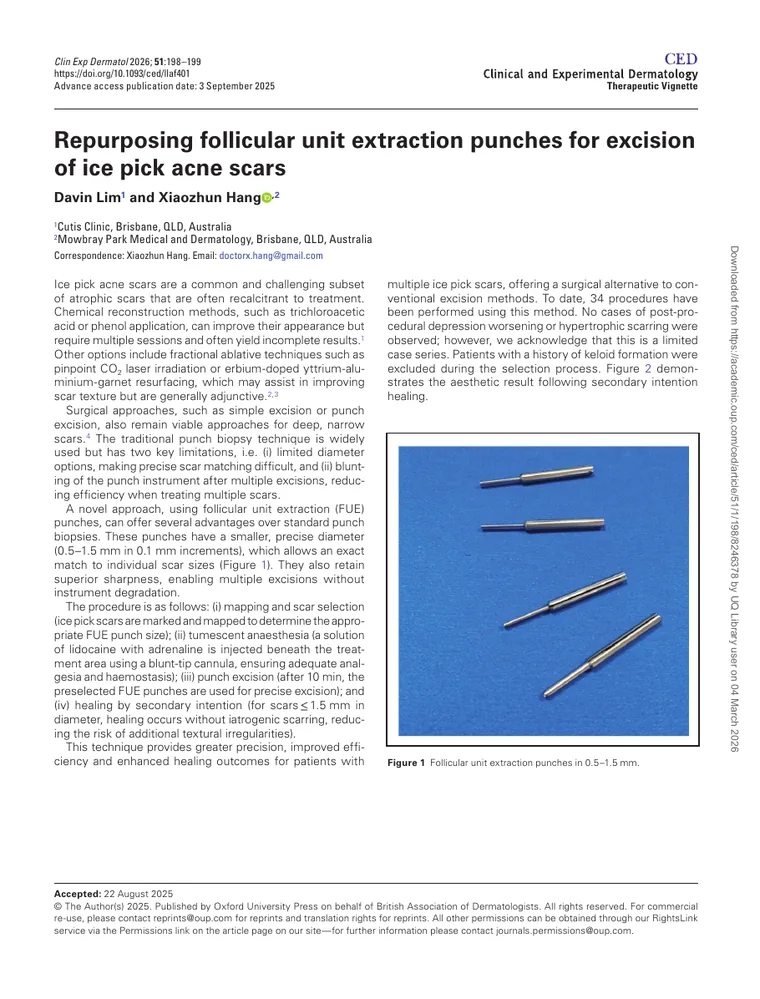
They come in 0.5 to 1.5 mm in 0.1 mm increments, so the punch can be matched exactly to each individual scar, and they hold their sharpness across multiple excisions.
Scars up to 1.5 mm heal without stitches.
Left to heal by secondary intention, wounds at or below 1.5 mm close without the iatrogenic scarring that suturing can introduce — which matters when you are treating many small scars at once.
Thirty-four procedures, no depression worsening and no hypertrophic scarring.
That is the whole safety experience to date, and it is reported as such.
What this means for you
Ice pick scars are a surgical problem
If your scars are narrow, deep and steep-sided, expecting a laser alone to close them is expecting the wrong thing from the right machine. Excision is a legitimate first-line answer for this specific type.
Not everyone is a candidate
Patients with a history of keloid formation were excluded from this series. If you scar thickly, this is a conversation to have before anything is cut.
Scar signature decides the treatment
Ice pick, boxcar and rolling scars all need different approaches, and most faces carry a mixture. A treatment plan that names only one technique is usually addressing only one of your scar types.
Why this matters
Atrophic acne scars are conventionally divided into ice pick, boxcar and rolling, and the distinction is not academic — each responds to a different intervention. Ice pick scars are the narrow, deep ones, and they are consistently the hardest to shift.
Punch excision has always been a reasonable answer for deep narrow scars. The obstacle has been the instrument: punch biopsy tools are made for taking tissue samples, not for matching the diameter of a 0.7 mm scar, and they lose their edge across a session. Follicular unit extraction punches were designed for precision and repeated use, which is exactly what this job needs.
Who was studied
A therapeutic vignette describing the technique and the experience with it so far: mapping and selecting the scars, tumescent anaesthesia beneath the treatment area, punch excision with the preselected sizes, and healing by secondary intention for scars at or below 1.5 mm.
- Procedures to date
- 34
- Punch range
- 0.5–1.5 mm
- Increments
- 0.1 mm
- Excluded
- History of keloid
What this study cannot tell you
Every study has a boundary, and it is fairer to state it than to leave you to guess.
- This is a limited case series and is described as one. Thirty-four procedures is experience, not evidence.
- There was no comparison group, so the technique has not been measured against standard punch excision or against TCA CROSS.
- Patients with a history of keloid formation were excluded, so nothing here applies to them.
- Outcomes are reported as the absence of specific complications rather than as a measured improvement score.
Questions people actually ask
What is the best treatment for ice pick scars?
There is no single answer, but ice pick scars respond least well to the treatments that work for other scar types. The realistic options are chemical reconstruction such as TCA CROSS, and surgical excision.
Lasers have a role in the overall texture of the skin around them, but for the ice pick scars themselves they are usually adjunctive rather than definitive.
Does cutting out an acne scar leave another scar?
It leaves a wound that has to heal, which is why size matters. At or below 1.5 mm, healing by secondary intention — left open rather than stitched — closes without the additional scarring that suturing can cause.
In the 34 procedures reported here, no patient developed worsening depression or hypertrophic scarring. Patients with a history of keloid were excluded.
How long does it take to heal?
Small punch wounds left to heal by secondary intention close over roughly a week to ten days, with the redness settling over the weeks after that.
The representative case in the paper was photographed at six weeks, showing resolution without additional scarring.
Cite this paper
Lim D, Hang X. Repurposing follicular unit extraction punches for excision of ice pick acne scars. Clinical and Experimental Dermatology. 2026. doi:10.1093/ced/llaf401
Related reading
Want this assessed properly?
A virtual consultation gives you a written report and a plan before we speak.
Published 2026 · Summary written and reviewed by Dr Davin Lim, FACD · General information, not personal medical advice.
Have some questions?
Send a message and it will be answered personally. Form endpoint — to be wired in production