Sweating somewhere new after underarm treatment
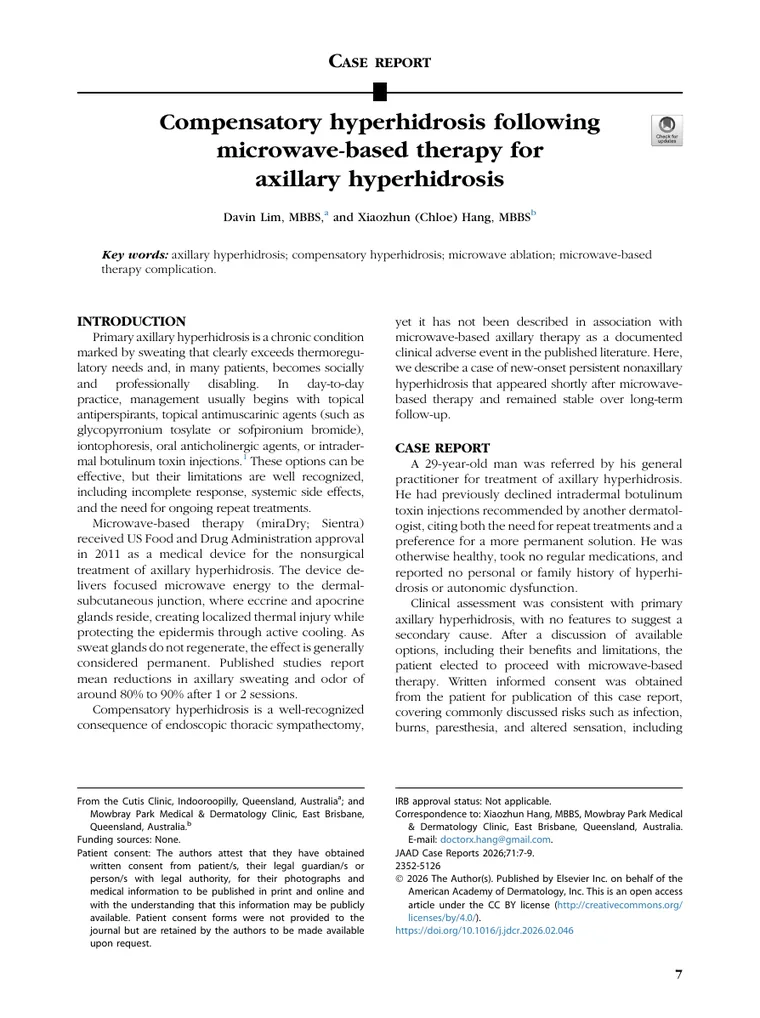
Compensatory hyperhidrosis following microwave-based therapy for axillary hyperhidrosis
A man had microwave treatment for underarm sweating and, twelve days later, started sweating across his lower back instead. Thirty months on it has not settled. It is the first time this has been reported after this treatment — and I am publishing it about a procedure I am closely associated with.
Four numbers worth knowing
What we found
The new sweating appeared twelve days after treatment.
A 29-year-old man with primary underarm sweating, who had declined injections because he wanted something more permanent, developed excessive sweating outside the underarm about twelve days after microwave-based therapy — most noticeable across the lower back, during both daytime activity and sleep.
The underarm sweating barely improved.
He reported only minimal improvement in the area actually treated, while examination confirmed both persistent underarm sweating and new truncal sweating. Visible beads of sweat were observed over the lower thoracolumbar region at rest in a temperature-controlled room, spanning the T10 to L3 dermatomes bilaterally, with surrounding skin normal.
Thirty months later it had not resolved.
Oral propantheline gave partial relief. At six, eighteen and thirty months both the axillary and the non-axillary sweating persisted without clear improvement or progression. A referral for surgical opinion was discussed and declined. Symptoms remained stable.
This pattern had never been reported after this treatment.
Compensatory sweating is a well-recognised consequence of ETS surgery. It has not been documented after microwave-based axillary therapy in clinical trials, long-term cohort studies, patient surveys or postmarket surveillance — despite the manufacturer listing it as a theoretical risk in consent materials.
The proposed mechanism is incomplete injury, not complete denervation.
We propose autonomic dysregulation following incomplete or uneven injury to the sweat glands and their nerve supply. Partial disruption of peripheral feedback, without complete denervation, may alter central thermoregulatory signalling and increase sweat output in anatomically distinct but sympathetically linked regions. An alternative is the unmasking of subclinical generalised hyperhidrosis.
The known complications of this device are otherwise mostly minor.
The reported literature describes swelling, pain, redness and bruising as common and transient; induration and temporary sensory change as recognised; and brachial plexus injury, nerve plexopathy, thermal burns and soft-tissue infection as rare. One fatal case of necrotising fasciitis has been reported — following off-label treatment of the genital and perineal region rather than standard underarm use.
One case does not make this a common outcome.
The paper states this explicitly: it does not imply that compensatory hyperhidrosis is a common or expected result of microwave-based therapy. It broadens the spectrum of reported patient experience and argues for continued postmarket surveillance.
What this means for you
Ask about this specifically before you consent
It is listed by the manufacturer as a theoretical risk, and until this report there was nothing in the published literature to put alongside that. Now there is one case, and you are entitled to know it exists.
“Permanent” cuts both ways
This patient chose the microwave treatment over injections precisely because he wanted something permanent. Sweat glands do not regenerate, which is the appeal — and also means an unwanted outcome may not be reversible either.
A poor result in the treated area is worth reporting early
Here the underarm sweating barely improved while new sweating appeared elsewhere. Both halves of that were relevant, and both were part of the picture that led to this being written up.
Rare is not the same as never
Most published complications of this device are transient. The serious ones are genuinely rare, and the one fatal case in the literature followed off-label treatment of an area the device is not intended for.
Why this matters
Microwave-based therapy has been available for underarm sweating since 2011 and is widely used, with published studies reporting 80–90% average reduction in sweating and odour after one or two sessions. Patient satisfaction is generally high, and the effect is considered permanent because sweat glands do not grow back.
Compensatory sweating — sweating that appears somewhere new after treatment elsewhere — is a well-known consequence of surgical sympathectomy. It had never been documented after this device. Publishing a case like this about a treatment one is publicly associated with is uncomfortable, and it is also the only way postmarket surveillance works.
What this case is, and is not
It is not evidence that compensatory sweating is a common outcome of microwave-based therapy. It is a reminder that unexpected patterns can emerge outside controlled study settings, that patients considering this treatment deserve to hear about it, and that continued surveillance after a device reaches the market has a point.
Who was studied
A single case report with thirty months of follow-up, alongside a tabulated summary of every adverse event associated with microwave-based therapy in the published literature — from the common and transient through to the very rare.
- Patient
- 29-year-old man
- Onset
- 12 days after treatment
- Distribution
- T10–L3, bilateral
- Follow-up
- 6, 18 and 30 months
- Outcome
- Stable, unresolved
What this study cannot tell you
Every study has a boundary, and it is fairer to state it than to leave you to guess.
- One patient. A single case cannot establish cause — only that the timing and distribution suggest an association in this individual.
- The proposed mechanism of autonomic dysregulation is a reasoned explanation, not a demonstrated one. No autonomic testing was performed.
- The alternative explanation — that pre-existing subclinical generalised hyperhidrosis was unmasked rather than caused — cannot be excluded.
- The paper states plainly that this does not imply compensatory hyperhidrosis is a common or expected outcome of the treatment.
- Follow-up ended at thirty months with symptoms stable. Whether they eventually settle is unknown.
Questions people actually ask
Can miraDry cause sweating somewhere else?
It is listed by the manufacturer as a theoretical risk in consent materials, and this case report is the first published description of it happening.
Twelve days after treatment this patient developed new sweating across his lower back, which was still present at thirty months. One case does not make it a common outcome, and the paper is explicit about that.
Is microwave treatment for underarm sweating safe?
The published complications are mostly local and transient — swelling, pain, redness, bruising, temporary numbness — and they usually settle without intervention.
Serious events are rare: nerve injuries, deep burns and infections have all been described. One fatal infection has been reported, following off-label treatment of the genital and perineal area rather than standard underarm use.
Does compensatory sweating go away?
In this patient it did not. Oral medication gave partial relief, but at six, eighteen and thirty months the sweating persisted without clear improvement or progression.
That is one patient's experience over two and a half years, not a prognosis. There is no other published case to compare it with.
Why publish a complication of a treatment you offer?
Because it had never been reported, and because the manufacturer already lists it as a theoretical risk without any published experience to put beside it.
Clinical trials and industry surveillance do not catch everything. A case that sits outside the expected pattern is worth writing down, even — particularly — when it concerns a procedure you are known for.
Cite this paper
Lim D, Hang X(. Compensatory hyperhidrosis following microwave-based therapy for axillary hyperhidrosis. JAAD Case Reports. 2026. doi:10.1016/j.jdcr.2026.02.046
Related reading
Want this assessed properly?
A virtual consultation gives you a written report and a plan before we speak.
Published 2026 · Summary written and reviewed by Dr Davin Lim, FACD · General information, not personal medical advice.
Have some questions?
Send a message and it will be answered personally. Form endpoint — to be wired in production