Eleven things fifteen years of scar work taught me
Tips and tricks for revising acne scars — what I have learned over 15 years
Eleven things fifteen years of acne scar revision taught me that are not in the textbooks: why the order of procedures matters more than the procedures, why you often do not need to treat the whole scar, what angled lighting reveals, and how to treat darker skin without trading a scar for a pigment problem.
Four numbers worth knowing
What we found
Scars sit in a face that is also ageing.
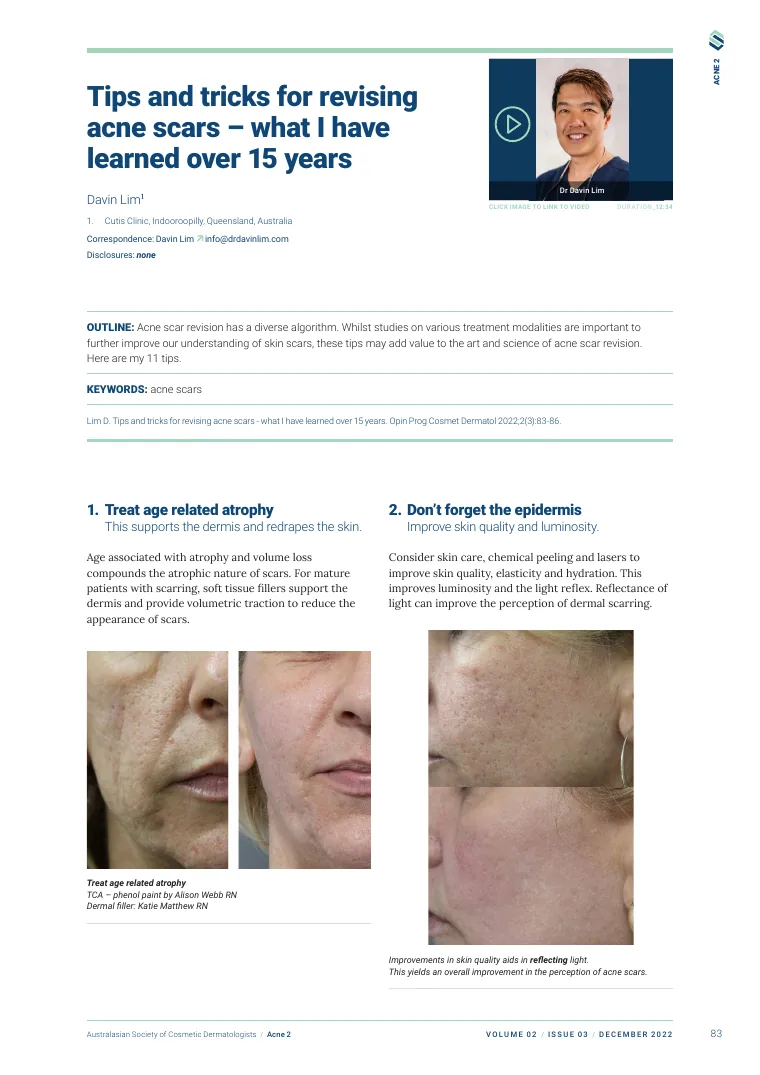
Age-related atrophy and volume loss compound the atrophic nature of the scars themselves. In older patients, soft tissue filler supports the dermis and provides volumetric traction that redrapes the skin and reduces how visible the scarring is — without any scar being treated directly.
Surface quality changes how deep scars are perceived.
Skin care, chemical peeling and lasers that improve skin quality, elasticity and hydration also improve luminosity and the way light reflects off the face. Better reflectance alters the perception of dermal scarring, which is a real gain even where the scar itself is unchanged.
You often do not need to treat the whole scar.
Polymorphic scars that do not fit any classification are common. Treating the portion that suits a given modality corrects that portion; other modalities, energy devices included, can then address what remains. One scar can take two treatments in two places.
Sequence matters, because fluid takes the path of least resistance.
Subcise before or during filler placement, never after. In fibrotic areas, filler flows around the scar rather than under it, producing donutting or overcorrection. Release the tethering first — and biostimulatory hyaluronic acids with a high tan delta are more forgiving because they integrate into tissue better.
Tumescent analgesia earns its place four times over.
It aids hydrodissection, gives better pain relief, reduces haematomas after subcision, and reduces damage to neurovascular bundles.
Two small equipment details prevent two avoidable problems.
Use undyed natural or blended bristle brushes for TCA and phenol paint — dyed brushes tattoo pigment into the skin. And orient the cutting plane of a subcision instrument deliberately, using markings on a locking syringe, a marked hub or a needle holder, which improves efficiency and reduces trauma to structures underneath.
Angled light shows contour that flat light hides.
Tangential lighting reveals contour change caused by scarring. It matters most when filler is being used, because it reduces the chance of overcorrecting something that looked deeper than it was.
In darker skin, pigmentation is expected and can be planned for.
In skin types 4 and above some post-inflammatory hyperpigmentation should be anticipated after energy devices or focal deep peeling. The technique described: a short pulse duration fractional laser, reduced density of 7–25% total coverage, that density split across two to four passes to limit bulk heating, topical corticosteroid for 48 hours afterwards, longer intervals between treatments, tyrosinase inhibitors started before and resumed once healed, early picosecond laser treatment of any pigmentation — and telling the patient beforehand that this is how darker skin heals.
A cannula can tell you how deep to set the device.
Using a cannula to gauge dermal thickness before selecting depth settings on an energy device matches the energy to the level the pathology actually sits at, which improves outcomes and reduces adverse events.
What this means for you
The order is part of the treatment
Release, then fill. Treat part of a scar, then the rest with something else. Start the pigment medication before the procedure, not after it. Several of these eleven points are about sequence rather than technique.
Forewarning is part of the result
Telling someone with darker skin that pigmentation is expected, before it happens, changes it from a complication into a stage of healing. The paper makes a point of the exact phrase to use.
Look at the whole face, not just the scars
Two of the eleven lessons — age-related volume loss and surface luminosity — improve the appearance of scarring without treating a single scar directly.
Why this matters
Studies on individual treatment modalities are essential, and they are also not where most of the difficulty lies. What determines the outcome of a scar revision is usually smaller and harder to publish: the order procedures are done in, how the light falls while you assess, which brush you use, how deep to set the device.
These eleven points are the things fifteen years of doing this taught me that no trial would ever be designed to test. They are written for clinicians, but several of them — the sequence of subcision and filler, the expectation of pigmentation in darker skin — are worth a patient understanding too, because they explain why treatment is staged the way it is.
Why it matters to you
If you have darker skin and have been warned off acne scar treatment entirely, this sets out the modifications that make it workable — lower density, more passes, longer gaps, and pigment medication started before the procedure rather than after the problem appears.
What this study cannot tell you
Every study has a boundary, and it is fairer to state it than to leave you to guess.
- These are clinical observations from one practitioner's experience, not findings from a study. Nothing here was measured against a control.
- The laser parameters given are a starting framework for darker skin, not a protocol; they depend on the specific device, the individual and the scar.
- Several points rest on instruments and techniques that require training to use safely — subcision and deep focal peels in particular are not procedures to attempt from a written description.
- Individual results vary widely with scar type, skin type and how the skin heals, and none of these tips changes that.
- The article is illustrated with clinical photographs of typical cases; they show what is achievable, not what is guaranteed.
Questions people actually ask
Why would fillers be used for acne scars if the problem is the scar?
Two reasons. For large rolling scars, filler placed under a released scar lifts it directly. Separately, in older patients, age-related volume loss makes existing scars look deeper — restoring that volume supports the dermis and redrapes the skin, improving how the scarring reads without treating any scar individually.
Why does subcision have to come before filler?
Because filler follows the path of least resistance. If a scar is still tethered down by fibrous bands, the filler flows around it rather than lifting it, which produces a ring of overcorrection around a scar that has not moved.
Releasing the tethering first means the filler goes where it is supposed to go.
Can acne scars be treated in darker skin?
Yes, with modifications. In skin types 4 and above, some post-inflammatory pigmentation should be expected after energy devices or deep focal peels — the approach is to plan for it rather than to avoid treatment.
That means lower fractional density, splitting the treatment across several passes, longer gaps between sessions, pigment-suppressing medication started beforehand, and treating any pigmentation early rather than waiting for it to fade.
Does the whole scar have to be treated at once?
Often not. Many scars are irregular and do not fit neatly into any single category, and different parts of one scar can suit different treatments.
Treating the portion that suits a given technique corrects that portion, and the remainder can be addressed separately — which usually gives a better result than forcing one modality across the whole thing.
Cite this paper
Lim D. Tips and tricks for revising acne scars — what I have learned over 15 years. Opinions and Progress in Cosmetic Dermatology. 2022;2(3):83–86.
Related reading
Want this assessed properly?
A virtual consultation gives you a written report and a plan before we speak.
Published 2022 · Summary written and reviewed by Dr Davin Lim, FACD · General information, not personal medical advice.
Have some questions?
Send a message and it will be answered personally. Form endpoint — to be wired in production